Comparisons
Local AI vs Frontier Labs: The Economics Flip in 2026
Outsourced inference plus local models is undercutting frontier APIs on price. Here's the real math on when self-hosting beats Claude, GPT, and Gemini.
Outsourced inference plus local models is undercutting frontier APIs on price. Here's the real math on when self-hosting beats Claude, GPT, and Gemini.
AI-assisted article · Facts from the sources linked below · No hands-on testing · How this site works
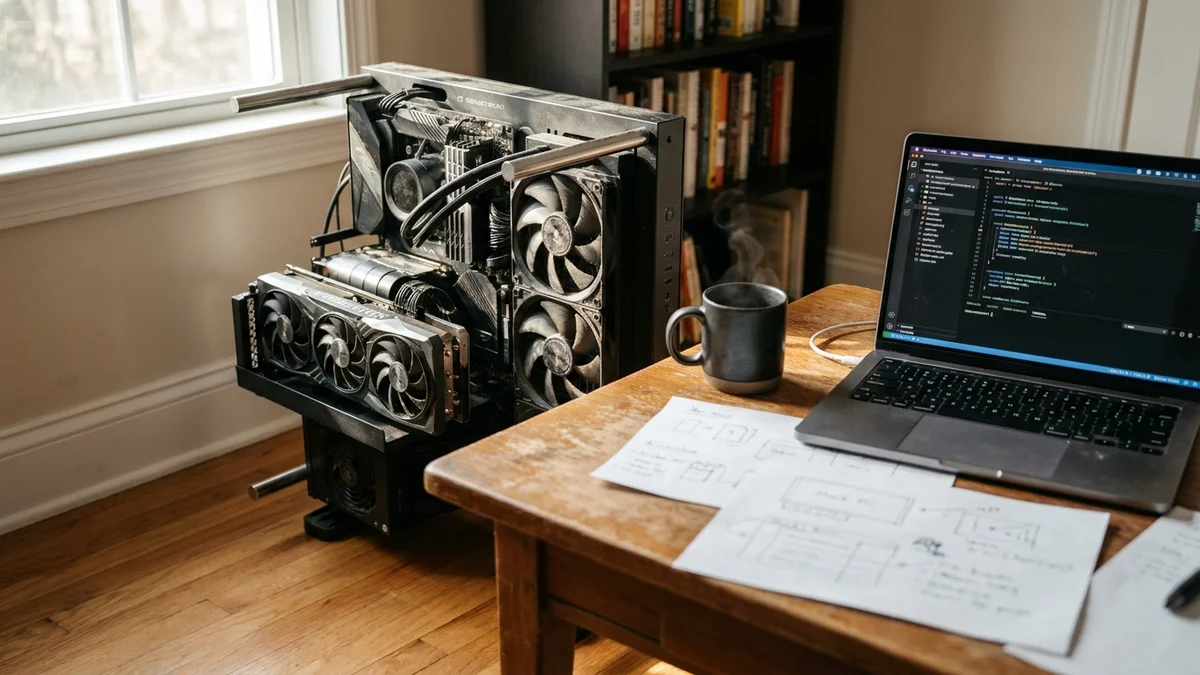
The cost gap between frontier AI labs and the open-source stack has collapsed faster than anyone predicted. A recent analysis on SignalBloom makes a sharp claim: outsourced inference combined with local AI deployment is about to become more economical than calling Claude Opus 4.6 or GPT-4o. And the math, as of mid-2026, basically backs it up.
But the picture is messier than the cheerleaders suggest. You don't just swap an API key and save 90%. There are quality cliffs, latency tradeoffs, and the kind of engineering overhead that quietly eats your margins.
This comparison breaks down where local AI vs frontier models actually pencils out, where it doesn't, and what the real total cost of ownership looks like in 2026.
If you're a solo dev or small team running fewer than 50 million tokens a month, frontier APIs still win on convenience and quality per dollar. Below that volume, the engineering cost of running your own stack wipes out the savings.

If you're processing 500 million+ tokens monthly, especially for non-frontier tasks like classification, summarization, or RAG retrieval, outsourced open-source inference (Together AI, Fireworks, Groq) is already cheaper, often by 5-10x.
And if you have predictable, high-volume workloads with privacy requirements, fully local deployment on an Apple M3 Ultra Mac Studio (256GB or 512GB) or a pair of RTX 4090s now competes on three-year TCO. Not on benchmark scores. On dollars.
The pricing gulf in 2026 is wider than ever. So is the quality gap, in some places.
| Tier | Example Model | Input ($/M tok) | Output ($/M tok) | MMLU |
|---|---|---|---|---|
| Frontier API | Claude Opus 4.6 | $5 | $25 | 92.3% |
| Frontier API | GPT-4o | $2.50 | $10 | 88.7% |
| Frontier API | Gemini 2.5 Pro | $1.25-$2.50 | $10-$15 | 90.8%* |
| Hosted OSS | Llama 4 Maverick (Together) | ~$0.27 | ~$0.85 | 87%* |
| Hosted OSS | DeepSeek V3 (Fireworks) | ~$0.27 | ~$1.10 | 89%* |
| Local | Llama 4 Scout on 2x RTX 4090 | Hardware amortized | Hardware amortized | 85%* |
*Community-reported scores, not always directly comparable to lab-reported numbers. Check the Papers with Code MMLU leaderboard for the latest.
Look at the output token gap. Claude Opus 4.6 charges $25 per million output tokens. A hosted Llama 4 Maverick endpoint runs around $0.85. That's roughly a 29x ratio. Even if you concede some quality, the spread is too wide to ignore for bulk work.
Frontier labs still own the top of the benchmark charts. Claude Opus 4.6 holds 92.3% on MMLU and 93.7% on HumanEval. o3 dominates reasoning with 96.7% on MATH and 87.5% on ARC-AGI (high compute). DeepSeek R1 closes the gap on MMLU at 90.8%, but reasoning benchmarks like GPQA Diamond still show a clear frontier moat: o3 at 87.7%, Claude Opus 4.6 at 74.9%, DeepSeek R1 at 71.5%.
For anything below true reasoning workloads, open models are now within a few percentage points of frontier ones. So if you're not doing competition math or PhD-level analysis, the quality argument for paying $25 per million tokens is wearing thin.
This is where Groq and Cerebras flipped the table. Groq serves Llama models at 600-1200 tokens per second. Frontier APIs typically run 50-150 tok/s. For agent loops where you're making 20 sequential calls, that 10x speedup compounds into a much better UX.
Local inference on consumer GPUs is the slow path. A single RTX 4090 running a quantized 70B model gets you maybe 25-40 tok/s. Fine for batch jobs. Painful for interactive chat.
Frontier API providers all offer enterprise tiers with no-training clauses and various compliance certifications. But the data still leaves your network. For HIPAA, certain financial workloads, and EU sovereignty requirements, that's a non-starter regardless of contracts.
Local AI deployment is the only architecture that gives you zero-egress guarantees. Hosted open-source providers like Together AI and Fireworks fall somewhere in between, since they offer dedicated endpoints with VPC peering, but your tokens still hit their infrastructure.
This is the hidden tax nobody talks about. An OpenAI API key takes ten minutes to integrate. Self-hosting a 70B model means GPU procurement, vLLM or TensorRT-LLM setup, quantization tuning, observability, fallback routing, version pinning, and an on-call rotation when the GPU server crashes at 3 AM.

Hosted open-source providers split the difference. You get the cheap tokens of open models with the operational simplicity of an API. For most teams making the local AI vs frontier models tradeoff, this middle path is probably the sweet spot in 2026.
Frontier labs let you fine-tune through their portals at premium prices. Open models let you LoRA-tune, merge, distill, and ship custom variants for the price of a few GPU-hours on RunPod. If your business depends on a model that knows your domain cold, this is a one-sided fight. Open wins.
Let's do a rough TCO calculation, because the vibes-based arguments don't help anyone.
A dual-RTX-4090 workstation costs roughly $5,000-$7,000 (check current pricing, GPU markets are volatile). Power draw under load is around 700W. At $0.12/kWh, that's about $735/year in electricity running 24/7. Amortize the hardware over three years and you're at roughly $2,000-$2,500 annual cost.
That box can serve a quantized 70B model at maybe 30 tok/s sustained. Over a year of continuous output, that's roughly 950 million tokens generated.
Compare that to Claude Opus 4.6 output pricing of $25 per million. 950 million tokens through the API would cost you about $23,750. The local box does it for ~$2,500.
The catch: 30 tok/s of a quantized Llama 4 Scout isn't the same product as Claude Opus 4.6. And if your actual usage is bursty, with 200 million tokens one month and 10 million the next, you're paying full freight for capacity you don't use. APIs win on elastic workloads.
Benchmark data shows the gap narrowing in some areas and widening in others. Here's what the public leaderboards report as of June 2026:
| Benchmark | Best Frontier | Best Open | Gap |
|---|---|---|---|
| MMLU | Claude Opus 4.6 (92.3%) | DeepSeek R1 (90.8%) | 1.5 pts |
| HumanEval | Claude Opus 4.6 (93.7%) | DeepSeek V3 (89.8%) | 3.9 pts |
| MATH | o3 (96.7%) | DeepSeek R1 (83.5%) | 13.2 pts |
| GPQA Diamond | o3 (87.7%) | DeepSeek R1 (71.5%) | 16.2 pts |
| SWE-bench Verified | Claude Opus 4.6 (72%) | DeepSeek R1 (49.2%) | 22.8 pts |
| GSM8K | o3 (99.2%) | DeepSeek V3 (95%) | 4.2 pts |
| ARC-AGI | o3 high compute (87.5%) | DeepSeek R1 (42%) | 45.5 pts |
The pattern is brutal but clear. On knowledge and basic coding, open models are essentially at parity (see our DeepSeek vs Llama 4 comparison). On hard reasoning, agentic coding, and abstract problem-solving, frontier labs still print money for a reason.
See the SWE-bench leaderboard for live numbers, since these scores move monthly.
If you're building anything that touches SWE-bench-style work, the agentic coding gap is too large to ignore. Claude Opus 4.6 with scaffolding hits 72% on SWE-bench Verified. DeepSeek R1 hits 49.2%. That's the difference between a working AI engineer and a frustrated one.
Long-context analysis also still favors frontier offerings. Gemini 2.5 Pro's 2M context is the biggest commercial window. Open models are catching up (Llama 4 Maverick hits 1M) but real-world recall at that scale is uneven.
And for low-volume usage under maybe 20 million tokens monthly, the API economics are simply unbeatable. Don't overthink it.
High-volume RAG pipelines. Bulk classification. Document summarization at scale. Anything where you're burning hundreds of millions of tokens on tasks that don't need PhD-level reasoning.
Groq and Fireworks AI are the obvious picks here. Together AI gets you fine-tuned variants. OpenRouter gives you a single API surface across dozens of providers, which is great for cost-routing logic. Cline and Aider users have been moving to hosted DeepSeek for cost reasons throughout the spring.
Predictable workloads with privacy or compliance requirements. Healthcare, legal, defense, finance back-office. Edge deployments where network round-trips are dealbreakers. Personal tinkering where you want maximum control.
A Mac Studio with M3 Ultra and 256GB unified memory now runs Llama 4 Maverick (4-bit quantized) comfortably (check the Ollama model library for current builds, or our Ollama vs LM Studio breakdown for picking a runtime). For one engineer doing heavy AI-assisted work, this is genuinely cheaper than a Claude Max subscription within 12-18 months.
The economics aren't that local AI will beat frontier labs on quality. They're that for 80% of real workloads, you don't need frontier quality, and the open ecosystem has finally caught up to that threshold.
A quick snapshot of where things stand:
For token-heavy workloads, even at the cheapest frontier tier (GPT-4o at $10/M output), hosted open source comes in at roughly 10x cheaper. That's not a tweak. That's a different business model.
The SignalBloom thesis holds up under scrutiny. Outsourced inference plus local AI has crossed the line where, for most production workloads, it's now the cheaper option. But cheaper isn't the same as better.
For frontier-quality reasoning, coding agents, and complex analysis: stick with Claude Opus 4.6 or o3 (our OpenAI vs Anthropic API breakdown digs into the per-token math). The benchmark gaps on GPQA, SWE-bench, and ARC-AGI aren't closing soon.
For high-volume production inference where quality is good-enough: hosted open source on Together AI, Fireworks, or Groq. The 10x cost savings are real and the operational overhead is minimal.
For privacy-critical or predictable workloads at scale: full local deployment. Mac Studio or a GPU server pays back in 12-24 months and gives you guarantees no API can offer.
The smart play in 2026 is probably all three. Route bulk classification to a cheap hosted endpoint. Route agentic coding to Claude. Run sensitive pipelines locally. The era of single-vendor AI architecture is ending.
Sources
Llama 4 Maverick is a 400B-parameter mixture-of-experts model (17B active). At FP16 the full weights run roughly 800GB, which means a multi-node setup. Quantized 4-bit versions land near 200GB and can run on a single Mac Studio with 256GB unified memory. A pair of RTX 4090s (48GB total) is only practical for the smaller Llama 4 Scout family with aggressive quantization. Check Ollama or vLLM docs for current quantization options.
Together AI and Fireworks both offer dedicated endpoints with BAA agreements for healthcare workloads, but their shared inference tiers are not HIPAA compliant by default. You need to specifically request enterprise tier with a signed BAA and use dedicated VPC endpoints. Pricing for these tiers is typically 2-3x the shared rates.
For a heavy user generating around 50 million output tokens per month with Claude Opus 4.6, you'd spend roughly $1,250/month on API. A $5,000 dual-RTX-4090 setup pays back in 4-5 months on raw token costs alone. For lighter usage under 5 million tokens monthly, the API is cheaper for 2-3 years.
Yes, this hybrid pattern is becoming standard. Tools like OpenRouter and LiteLLM let you route requests based on complexity, cost, or latency requirements. A common pattern routes simple tasks (classification, extraction) to cheap hosted open-source endpoints and reserves frontier APIs for reasoning-heavy steps.
Frontier prices have dropped roughly 80% in 18 months, but open-source inference costs have dropped even faster due to inference-optimization advances like FlashAttention and speculative decoding. As long as open models stay within striking distance of frontier benchmarks, the cost ratio favors open and local deployment.
This article was researched and written with AI assistance (Anthropic's Claude) using the sources cited above, and published by Shadman Ahmed, a software architect who runs AI Bytes. We don't run our own model tests or benchmarks. If something here is wrong or out of date, please tell us.