Comparisons
Claude vs GPT-5: The 2026 Showdown That Actually Matters
A clear-eyed breakdown of Claude Opus 4.8 against GPT-5 on price, coding, reasoning, and honesty. Plus the verdict on which one actually deserves your API budget.
May 29, 2026
A clear-eyed breakdown of Claude Opus 4.8 against GPT-5 on price, coding, reasoning, and honesty. Plus the verdict on which one actually deserves your API budget.
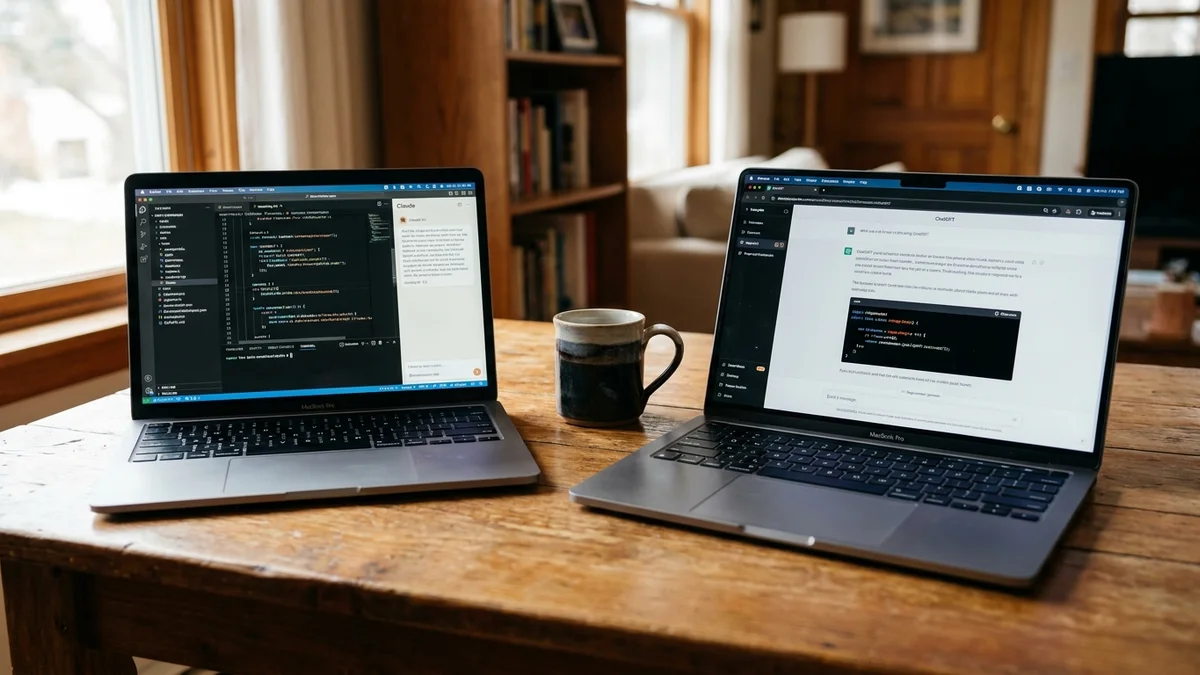
Anthropic just shipped Claude Opus 4.8 with a feature that sounds boring but is actually a big deal: it tells you when it's guessing. According to The Verge's coverage, the new model is roughly 4x less likely than its predecessor to confidently present unsupported claims as facts.
Meanwhile, OpenAI's GPT-5 has been the rumor mill's favorite punching bag for the better part of a year, and it's finally a real product people are paying real money for. So which one should you actually be writing checks to?
This is the Claude vs GPT-5 breakdown nobody asked for but everybody needs. We'll go through pricing, benchmarks, coding ability, reasoning, agentic workflows, and the squishy stuff like honesty and refusal rates. No vibes, just numbers and opinions.
Worth flagging: if you're building production code, agents, or anything where being wrong is expensive, Claude is the better default in mid-2026. If you're doing massive multimodal work, ChatGPT-style consumer experiences, or you need the absolute best math reasoning, GPT-5 is the call. And if your budget is tight, neither is cheap, so plan accordingly.

The short answer to the Claude vs GPT-5 question depends almost entirely on what you're actually shipping. Developers and analysts: Claude. Generalists and consumer apps: GPT-5. Cost-sensitive workloads: look at Sonnet tier or open models like DeepSeek instead.
| Spec | Claude Opus 4.8 | GPT-5 |
|---|---|---|
| Context window | 200K tokens | 256K tokens (reported) |
| Input price | $5 / M tokens | check official pricing |
| Output price | $25 / M tokens | check official pricing |
| Native multimodal | Vision, PDFs | Vision, audio, video |
| Agentic tooling | Claude Code, MCP | Codex, Operator |
| Best at | Coding, analysis, honesty | Math, multimodal, breadth |
| Honesty/refusal | Lower hallucination | Stronger guardrails |
Pricing on Claude Opus 4.8 holds the Opus 4.x pattern Anthropic has been using since late 2025: $5 per million input tokens, $25 per million output tokens. Sonnet 4.6 remains the cost-effective sibling at $3/$15 per million tokens, and that's the one most teams should actually be calling. GPT-5 pricing has shifted a couple of times since launch, so always check the OpenAI pricing page before committing to architecture.
Claude has owned this category for two years and Opus 4.8 doesn't give it up. On SWE-bench Verified, Claude Opus 4.6 with scaffolding clears the low-70s range per Anthropic's published numbers, comfortably ahead of OpenAI's o3 at 69.1%. Early reports on Opus 4.8 suggest another meaningful jump, though Anthropic hasn't published official numbers across every benchmark yet.
GPT-5 closes some of the gap but still lags on real-world software engineering tasks. The reason isn't raw intelligence, it's training emphasis. Anthropic has poured an absurd amount of post-training compute into agentic coding, and it shows when you actually use Claude Code to refactor a 50-file repo.
HumanEval at this point is basically saturated for frontier models — Opus 4.6, GPT-4o, and GPT-5 all sit in the 90% range, which means the benchmark stopped being useful a year ago. SWE-bench Verified is where the truth lives now, and Claude is still the king of that one.
And not gonna lie, anyone who's lived in Claude Code for a month has a hard time going back. The tool-use loop is just tighter.
This is where GPT-5 fights back, and fights back hard. OpenAI's reasoning lineage (o1, o3) crushed Anthropic on pure math and competition-style problems, and GPT-5 inherits that DNA.
On the MATH benchmark, o3 famously cleared the high-90s while Claude Opus 4.6 sits noticeably behind in the mid-80s. On GPQA Diamond (PhD-level science questions), o3's lead is similar. GPT-5 reportedly extends both leads further.
If you're doing scientific research, quantitative finance, or anything where the model needs to chew on a problem for minutes, GPT-5 is genuinely better. Claude's extended thinking mode helps but doesn't fully close it.
ARC-AGI tells the same story even more dramatically: o3 with high compute famously hit the high-80s, while Claude sits well below it. That benchmark is controversial (it's basically a logic puzzle test that OpenAI optimized heavily for), but the gap is real.
Claude Opus 4.8 sticks with the 200K token context that's been standard since Claude 2.1. GPT-5 pushes to a reported 256K tokens. Neither comes close to Google's 1M+ token Gemini windows, but for most practical use cases both are fine.

Where it matters: long codebases, legal documents, and book-length analysis. In those workflows, Gemini is still the move if context is the bottleneck. For everything else, the practical difference between 200K and 256K is basically nothing.
One caveat. Claude's effective context (the range where retrieval stays sharp) has historically been better than nominal context windows from competitors. Independent needle-in-a-haystack tests on the Claude 4 family have consistently shown clean recall across the full window. GPT-5 claims similar but it's still early.
GPT-5 wins this round and it isn't close. Native voice, native video understanding, and Sora-style generation integrated into the same model stack. Claude handles vision and PDFs well but it's playing catch-up on audio and video.
If your product is a consumer chat app, an accessibility tool, or anything that needs to see and hear, GPT-5 is the obvious pick. If you're processing screenshots and documents, Claude is fine.
Both labs have shipped serious agent products this year. Anthropic has Claude Code (terminal-native agentic coding) and MCP as an open standard for tool connections. OpenAI has Codex (cloud-based coding agent) and Operator (browser agent).
The philosophical difference is interesting. Anthropic is betting on open protocols and IDE/terminal integration. OpenAI is betting on hosted, sandboxed cloud agents. Both approaches work, and which one you prefer says more about your dev preferences than the underlying capability.
For day-to-day work, Claude Code feels more useful in 2026. Operator is impressive in demos but flaky in production (the browser is just a hostile environment). For a deeper apples-to-apples on the coding agent side, see our Claude Code vs Cursor vs Copilot showdown.
Here's the Opus 4.8 angle that triggered this whole article. According to Anthropic, the new model is 4x less likely to make unsupported claims compared to Opus 4.6. In practical terms, it'll tell you when it didn't actually verify something, when its work is incomplete, or when it ran out of context.
That sounds boring until you've shipped a feature where the model confidently lied about its progress and you didn't find out until QA. So yes, this matters. A lot.
Honesty is a feature, not a personality trait. When a coding agent runs for 40 minutes and then tells you it 'completed the refactor' but actually skipped half the files, you don't need a smarter model, you need a more honest one.
GPT-5 has improved on hallucination but doesn't market honesty as a primary feature the way Anthropic does. In community testing, Claude tends to refuse less on legitimate requests while also being more candid about uncertainty. GPT-5's refusal behavior is stricter, which some users like and others find infuriating.
List prices are misleading. What matters is cost per useful task, which depends on output length, retry rate, and how often you have to call a more expensive model to fix a cheaper one's mistakes.

That said, here are the sticker prices for the Opus tier as of mid-2026:
| Model | Input ($/M) | Output ($/M) |
|---|---|---|
| Claude Opus 4.8 | $5 | $25 |
| Claude Sonnet 4.6 | $3 | $15 |
| GPT-5 | check pricing | check pricing |
| GPT-4o | $2.50 | $10 |
| Gemini 2.5 Pro | check pricing | check pricing |
Claude Opus sits at the high end for an agentic-coding flagship, but Anthropic's pricing reset (down from the Opus 3 era's $15/$75) means it's no longer the eye-watering line item it used to be. If you're running serious volume, the cost difference between Opus 4.8 and Sonnet 4.6 is the conversation you should be having, not Opus vs GPT-5.
The smart play for most teams: use Sonnet 4.6 or GPT-4o for the bulk of work, escalate to Opus 4.8 or GPT-5 only when the cheaper model fails. Routing is the new optimization frontier. The OpenAI vs Anthropic API breakdown covers the routing math in more detail.
Here's where the available data lands. Numbers below come from each lab's published benchmarks (self-reported, scaffolded where noted), not independent third-party runs.
| Benchmark | Claude (Opus 4.6) | OpenAI |
|---|---|---|
| SWE-bench Verified | ~72% (Opus + scaffold) | o3 ~69.1% |
| HumanEval | saturated (~90%+) | saturated (~90%+) |
| MATH | mid-80s range | o3 mid-90s |
| GPQA Diamond | mid-70s range | o3 high-80s |
| ARC-AGI | low-50s | o3 high-80s (high compute) |
| Multimodal (voice/video) | limited | native (Sora-derived) |
GPT-5 numbers are still settling and several benchmark organizations haven't published official scores. Where GPT-5 lands publicly, expect it to push past o3 on most reasoning benchmarks while staying competitive on coding.
The takeaway: Claude wins coding. OpenAI wins reasoning and math. Multimodal is OpenAI's. Honesty and structured tool use is Claude's. On general chat quality (LMSYS Arena style), the two trade leads within margin of error.
Reach for Claude (Opus 4.8 or Sonnet 4.6) when:
The honest answer is that Claude has become the developer's model. If your product touches code, Claude is probably the right call.
Reach for GPT-5 when:
GPT-5 is the safer default for non-developer products. The brand recognition alone is worth something, and the multimodal breadth is genuinely unmatched.
Claude vs GPT-5 isn't really a fight, it's a fork in the road. Anthropic is building for engineers and enterprises that care about reliability. OpenAI is building for everyone, with a heavy lean toward consumer and multimodal experiences.
Both models are pretty solid. Both make mistakes. Both will get cheaper by 30% within a year, which is a frustratingly consistent pattern in this industry (the same thing happened with GPT-4 in 2024).
If you're a solo developer, Claude Code with Opus 4.8 is the most productive single tool we've seen since GitHub Copilot launched. If you're building a consumer product where users want to talk to their phone and have it understand their kitchen, GPT-5 is the only option.
And if you're an enterprise architect reading this for procurement decisions: route between both. There's no good reason to commit to one provider in 2026 when the spread between best-in-class capabilities is this wide and pricing keeps shifting.
The takeaway after a year of using both: pick the right tool for the job, never marry one vendor, and budget for routing. The Claude vs GPT-5 question has stopped being a tribal allegiance and started being a portfolio decision.
Sources
Per Anthropic's pricing docs, Claude Opus 4.8 lists at $5 input / $25 output per million tokens. GPT-5's published pricing has moved a few times since launch, so always check OpenAI's pricing page before committing. The headline gap closes when you account for output verbosity and retry rates on coding tasks: Claude Opus tends to produce more accurate first attempts in code-heavy workflows, so cost per successful task is often closer than the sticker prices suggest.
Yes, and most serious production teams do exactly this in 2026. Common patterns: route coding tasks to Claude, reasoning and multimodal tasks to GPT-5, and use a cheaper model like Sonnet 4.6 or GPT-4o for high-volume simple calls. Libraries like LiteLLM and OpenRouter make multi-provider routing fairly painless and let you swap providers without rewriting business logic.
No. Claude can read and analyze images but cannot generate them, while GPT-5 includes Sora-derived image and video generation. If you need generation, you'll need to pair Claude with a model like DALL-E 3, Flux, or Midjourney via API. For pure analysis of existing images, both models perform comparably well.
GPT-5 generally refuses more requests in edge-case territory like security research, fiction with violence, or sensitive medical questions, while Claude refuses less but is more candid about uncertainty. Anthropic's constitutional AI approach tends to engage with nuanced requests rather than blanket-refusing. For research and red-teaming contexts, Claude is usually the more cooperative partner.
Based on the 2025 to 2026 release cadence, Anthropic has shipped a meaningful Claude update roughly every 3 to 5 months, with point releases (like the 4.6 to 4.8 jump via 4.7) clustering closer together than major version changes. The next major Claude generation is likely in late 2026 based on this pattern, but Anthropic has not committed publicly to a date.