Tutorials
How to Use AI for SEO: A 7-Step Playbook for 2026
A practical, 7-step workflow for using AI to handle keyword research, SERP analysis, content briefs, and on-page optimization without triggering Google's spam filters.
June 6, 2026
A practical, 7-step workflow for using AI to handle keyword research, SERP analysis, content briefs, and on-page optimization without triggering Google's spam filters.

Google's March 2026 core update was the latest in a string of crackdowns on low-effort, AI-generated content farms. So why are smart content creators still betting big on AI for SEO?
Because used correctly, AI compresses a 10-hour keyword research session into 45 minutes without setting off spam signals. The trick is knowing where to apply AI in the workflow, and more importantly, where to keep human judgment in the loop.
This tutorial walks through how to use AI for SEO across the full content lifecycle, from keyword discovery to monthly performance audits. No fluff. No "10x your traffic" promises. Just a workflow that respects Google's helpful content guidelines.
By the end of this guide, you'll have a repeatable AI SEO workflow covering:
And the good news: most steps work with the free tier of common AI tools.
Before starting, you need:
That's it. No coding required for the core workflow.
Old-school keyword research means dumping 500 keywords into a spreadsheet and praying something sticks. AI changes the math by clustering keywords semantically before you write a single brief.
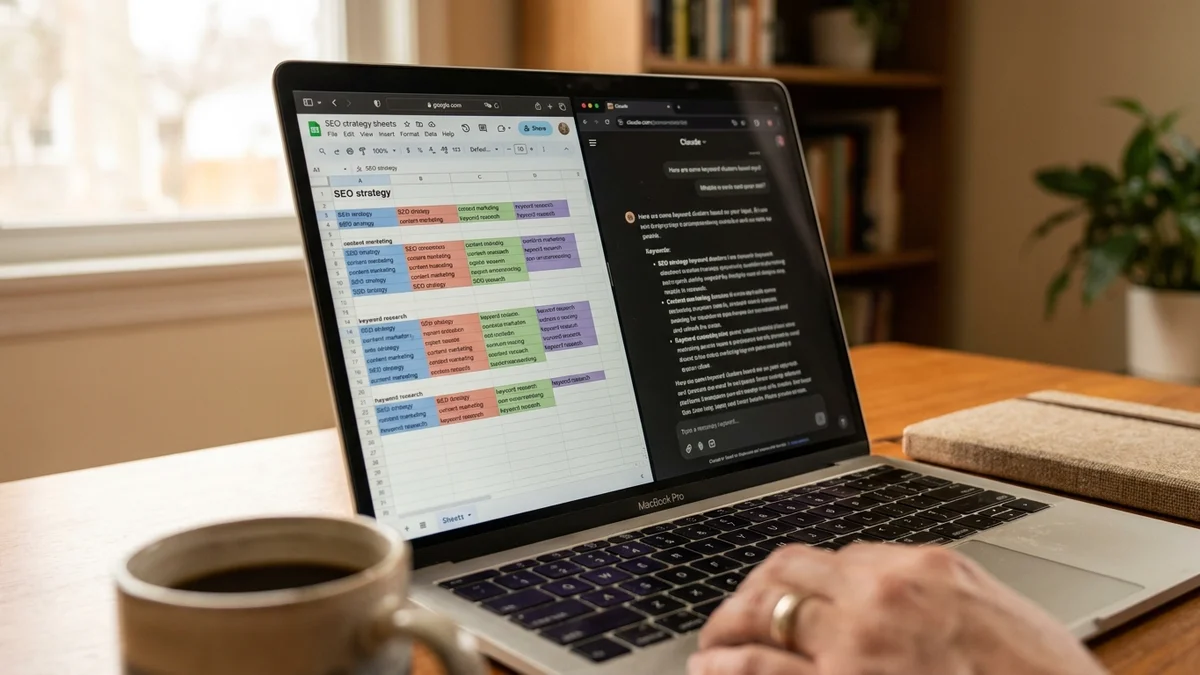
Open Claude or ChatGPT and paste this prompt:
You are an SEO strategist. I'll give you a seed topic and 50-100
keywords from my keyword tool. Group them into 5-8 semantic clusters
based on search intent. For each cluster, output:
- Cluster name
- Primary keyword (highest volume)
- Search intent (informational/commercial/transactional)
- Suggested article format (guide, comparison, listicle)
- 3 long-tail variants

Seed topic: [your topic]
Keywords: [paste list]
According to Ahrefs research, 96.55% of pages get zero search traffic from Google. Most of those pages either target keywords nobody searches for, or they fight for terms way above their domain authority. Semantic clustering fixes both problems by surfacing long-tail variants where you can actually win.
In practice, Claude tends to be slightly more consistent on long keyword lists, but any frontier model works. The key is feeding it real data from your keyword tool, not asking it to invent volumes.
Once you've picked a cluster to attack, reverse-engineer the SERP. Open the top 10 results and ask Perplexity what they cover. The prompt:
Visit these 10 URLs and create a content gap analysis:
- What topics do ALL of them cover?
- What topics does only 1-2 cover (potential differentiators)?
- What questions appear in "People Also Ask" but aren't
  answered well in the top results?
- What's the average word count?
- What format dominates (listicle, guide, comparison)?
Perplexity makes this practical because it actually visits the URLs instead of hallucinating their contents. NotebookLM works too if you prefer Google's stack.
A pro tip from working SEO consultants: the gaps usually live in the "People Also Ask" box. Google literally tells you what's missing from the top results. Most writers ignore this.
This is where AI for SEO earns its keep. A solid brief turns a 6-hour writing session into 2 hours and dramatically improves first-draft quality.
Feed your SERP analysis back into Claude with this prompt:
Build a content brief for the keyword "[primary keyword]". Include:
- Target word count (match top 3 average + 15%)
- H2/H3 outline covering all common topics
- 5 unique angles competitors miss
- Internal linking suggestions from my site (I'll provide a sitemap)
- Schema markup recommendations (Article, FAQPage, HowTo)
- Target featured snippet question with 40-60 word answer
The schema markup suggestion alone is worth the prompt. According to Google's structured data docs, properly marked-up content qualifies for rich results, which drive significantly higher CTR than plain blue links.
Now the controversial part. Should you let AI write the draft?
Honest answer: yes, but with heavy human revision. Pure AI content gets demoted in core updates. AI-assisted content written with a clear point of view ranks just fine. The difference is editorial input.
Use a two-pass approach:
A reasonable target is 40% AI-written, 60% human-revised by word count. The AI provides scaffolding. You provide expertise (and the part Google's algorithm actually rewards).

Tools like Grammarly help catch the AI tells in your final pass. Phrases like "in today's digital age" or "the world of marketing" scream automation, and human editors catch them faster than detection tools do.
Before publishing, run your draft through a checklist. Claude handles this well with the following prompt:
Audit this draft against the following SEO checklist:
- Primary keyword in title, H1, first 100 words, and URL slug
- Primary keyword density 0.5-1.5% (count occurrences, give exact %)
- 3-5 internal links to relevant existing posts
- 2-4 external links to authoritative sources
- Featured snippet answer in first 200 words after relevant H2
- Image alt text descriptive and includes secondary keywords where natural
- Meta title under 60 chars, meta description under 155 chars
- Schema markup specified
- Mobile-friendly formatting (short paragraphs, scannable lists)

Output a pass/fail for each item with specific fixes.
This single prompt replaces an hour of manual checking. And it catches things humans miss, like forgetting to add the primary keyword to the URL slug.
Internal links are SEO's biggest underrated lever. Most sites have terrible internal linking because the manual work is tedious. AI makes it tractable.
Export your sitemap as a CSV with URL, title, and meta description for each post. Then prompt:
I'm publishing a new article on [topic]. Here's my sitemap CSV.
Suggest 5-7 internal links FROM existing posts TO this new article,
and 3-5 internal links FROM this new article TO existing posts.
For each suggestion, specify:
- Source URL
- Anchor text (varied, not exact match every time)
- Where in the post to insert it (which section)
The varied anchor text matters. According to Google's link spam guidelines, keyword-stuffed anchor text patterns trigger penalties. Letting AI generate three different anchor variations per link target solves the problem in 30 seconds.
The work doesn't end at publish. Set up a monthly AI-assisted audit:
Analyze this GSC export. Identify:
- Pages that lost >20% traffic month-over-month (refresh candidates)
- Keywords ranking positions 11-20 (close to page 1, easy wins)
- Pages with high impressions but CTR under 2% (title/meta rewrites)
- Topics with growing impressions but no dedicated page (new content)
This single workflow drives more measurable results than most AI content SaaS products promise. And it costs nothing beyond your existing AI subscription.
Mistakes to dodge:
And the biggest one: treating AI as a replacement for expertise. AI accelerates SEO work. It doesn't replace knowing your audience.
How do you know the workflow is working? Track these metrics for 90 days after implementing:
If you don't see lift after 90 days, the problem is usually keyword targeting, not the AI workflow itself. Audit your cluster selection first before blaming the prompts.
A reasonable order of operations:
Don't try to AI-optimize your entire site in one weekend. The wins compound when you build the workflow into your regular publishing rhythm, not when you sprint through a one-time overhaul.
For deeper reading, Search Engine Journal's AI category tracks how Google's algorithm responds to AI content month by month. Worth a bookmark if you publish at any kind of volume.
Sources
Yes, but only with heavy human editing. Google's March 2026 core update specifically targeted thin AI content with no original perspective. Articles that mix AI drafting with human expertise, original data, and clear point of view continue to rank fine. The 40/60 split (AI-written to human-revised) is a common benchmark among SEO practitioners.
Claude Opus 4.6 and ChatGPT (GPT-4o) both handle semantic clustering well, and in practice Claude tends to give slightly more consistent results on long keyword lists. For SERP analysis specifically, Perplexity is better because it actually visits URLs in real time instead of working from training data.
A working setup runs $20-50/month for solo creators: $20 for ChatGPT Plus or Claude Pro, plus optional $20 for Perplexity Pro. Keyword tools like Ahrefs ($129+) and Semrush ($149+) are the bigger expense, though Google Keyword Planner is free if you run Google Ads. The entire workflow is achievable for under $200/month total.
For small to mid-size content sites, often yes. AI workflows handle the tactical execution (keyword clustering, briefs, audits) that agencies charge $2-5K/month for. What AI cannot replace is strategic positioning, link building outreach, and technical SEO audits on complex sites. Most solo creators and small teams should run the AI workflow first and only hire help for what it cannot do.
Expect 60-90 days for new articles on established domains to reach stable rankings. New domains take 4-6 months minimum due to the sandbox effect. Refreshing existing content using the Step 7 workflow typically shows ranking lift within 30 days because Google already trusts the URL.