Google's $12.5M AI Open Source Security Push, Explained | AI Bytes
0% read
Google's $12.5M AI Open Source Security Push, Explained
AI News
Google's $12.5M AI Open Source Security Push, Explained
Google, Microsoft, OpenAI, and Anthropic are pooling $12.5 million to secure open source software — and Google's AI tools Big Sleep and CodeMender are already finding and fixing real vulnerabilities.
March 19, 2026
6 min read
653 views
Updated June 19, 2026
Google Just Put $12.5 Million Behind Fixing Open Source Security
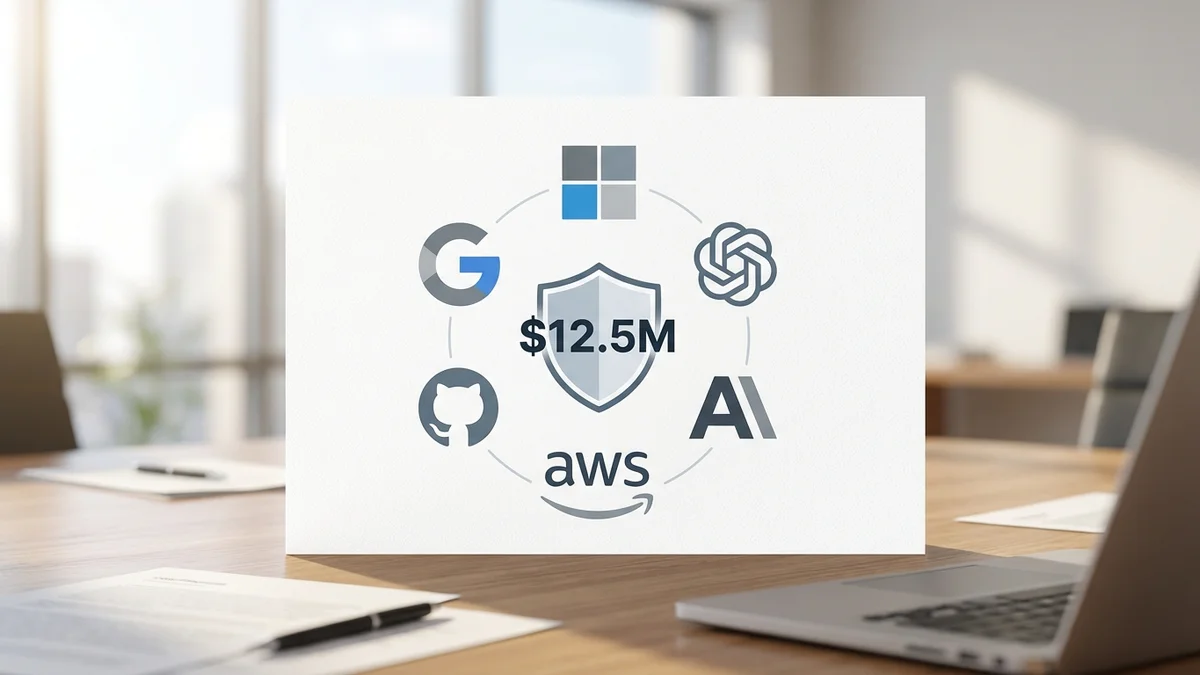
What happens when the software that runs 70-90% of modern applications is maintained by unpaid volunteers drowning in AI-generated bug reports? You get a crisis. And on March 17, 2026, Google — alongside Microsoft, OpenAI, Anthropic, AWS, and GitHub — decided to do something about it, announcing a $12.5 million commitment to the Linux Foundation to shore up open source security in the AI era.
But the money is only half the story. Google is also deploying its own AI-powered security tools — Big Sleep and CodeMender — to actively hunt and patch vulnerabilities in open source projects. This isn't a vague pledge. It's code shipping right now.
Why Open Source Security Needs a $12.5 Million Lifeline
Look — AI tools have gotten very good at finding bugs. Too good. Maintainers of critical open source projects are now buried under security reports — many auto-generated by AI scanners — without the time, resources, or staffing to triage them. It's like giving someone a metal detector that beeps constantly but never tells you which signals are landmines.
Open source makes up 70-90% of the code in modern applications. When it breaks, everything breaks.
The $12.5 million in grants will be managed by Alpha-Omega and the Open Source Security Foundation (OpenSSF), two organizations that have already distributed over $20 million across 70+ grants to major ecosystems and package registries. The contributing organizations — Anthropic, AWS, GitHub, Google, Google DeepMind, Microsoft, and OpenAI — represent pretty much every major player in AI right now.
As of March 2026, the funding will go toward three priorities: helping maintainers handle the flood of AI-generated security reports, moving beyond just finding vulnerabilities to actually deploying fixes, and putting advanced security tooling directly into maintainers' hands.
"Alpha-Omega was built on the idea that open source security should be both normal and achievable," said Michael Winser, co-founder of Alpha-Omega.
Big Sleep: The AI That Caught a Zero-Day Before Hackers Did
Google's first headline-grabbing security tool is Big Sleep, an AI agent developed by Google DeepMind. And its track record is already impressive.
Big Sleep discovered a critical exploitable vulnerability in SQLite, one of the most widely deployed database engines on the planet — and caught it before it appeared in an official release. Google described it as "the first public example of an AI agent finding a previously unknown exploitable memory-safety issue in widely used real-world software." The bug was reported to SQLite developers and fixed the same day.
That's not a small deal. Traditional vulnerability scanners find bugs after they're already known. Big Sleep caught one before it ever shipped — the difference between a smoke detector and a firefighter.
Big Sleep found the SQLite vulnerability before it shipped in a release — the first public case of an AI agent catching a real-world exploitable bug.
CodeMender: Google's AI Agent That Actually Writes the Patches
Finding vulnerabilities is one thing. Fixing them is another. And that's where CodeMender comes in — Google DeepMind's AI agent that doesn't just flag security issues but rewrites the code to eliminate them.
As of March 2026, CodeMender has submitted 72 security fixes to open source projects, some containing up to 4.5 million lines of code. It uses Gemini Deep Think models to power an autonomous debugging agent that can:
Run static and dynamic analysis on vulnerable code
Use fuzzing and SMT solvers to verify the root cause
Generate patches that fix the vulnerability without introducing regressions
Validate fixes across multiple dimensions before human review
The approach is both reactive (patching new vulnerabilities instantly) and proactive (rewriting code to eliminate entire classes of bugs). One notable example: CodeMender applied -fbounds-safety annotations to libwebp, the image compression library used by basically every web browser.
All patches still go through human researcher review before submission. But the vision is clear — Google wants CodeMender to eventually ship as a developer tool that maintainers can point at their codebases.
How CodeMender Validates Its Own Fixes
This is the part that separates CodeMender from a glorified autocomplete. The agent runs an LLM-based critique tool that compares the original and modified code line-by-line, checking that the patch:
Fixes the actual root cause (not just the symptom)
Maintains functional correctness
Introduces zero regressions
Follows the project's existing style guidelines
Open source maintainers are famously (and rightly) picky about code style. A security fix that looks like it was written by a different programming language gets rejected fast.
Sec-Gemini and OSS-Fuzz: The Wider Arsenal
Google isn't stopping at Big Sleep and CodeMender. Two other tools round out the security push.
Sec-Gemini is a cybersecurity-focused AI model built on Google's Gemini architecture. As of March 2026, it integrates with Google Threat Intelligence, the OSV (Open Source Vulnerabilities) database, and other real-time data sources. Google is extending Sec-Gemini to open source projects and making it freely available to selected organizations and researchers for security work.
OSS-Fuzz, Google's continuous fuzzing service, has already uncovered over 11,000 vulnerabilities across 1,000+ open source projects. It's been running for years, but the AI enhancements from Gemini models are expected to dramatically expand its reach — using LLMs to understand code context and detect subtle logic flaws that traditional pattern-matching misses.
Google's security stack — Big Sleep, CodeMender, Sec-Gemini, OSS-Fuzz — covers the full lifecycle from detection to patching.
The Bigger Picture: AI Arms Race in Code Security
Look — about what's happening here. AI has created a problem and now AI is being deployed to fix it. The same models that make it easier for attackers to discover and weaponize vulnerabilities are now being turned into defensive tools.
Google has committed billions to cybersecurity initiatives since 2021, including direct support for open source security programs. This $12.5 million announcement — shared across seven organizations — is arguably more targeted than previous efforts. The focus has shifted from "we should care about this" to "here are specific tools that work."
And Google isn't alone in the space. Microsoft has expanded Defender for DevOps, and Amazon has integrated security scanning into its CodeGuru Reviewer tooling. But Google's combination of Big Sleep (detection), CodeMender (patching), Sec-Gemini (threat intelligence), and OSS-Fuzz (continuous fuzzing) is the most complete AI-powered security pipeline any company has publicly shipped. For developers weighing their platform options, this security investment adds another dimension to consider — as we explored in our Railway vs AWS comparison.
Steve Fernandez, OpenSSF General Manager, put it simply: "Our commitment remains focused: to sustainably secure the entire lifecycle of open source software."
Kyle Daigle, GitHub's COO, added: "Supporting these initiatives extends our longstanding commitment to securing the global software supply chain."
What This Means for Developers
If you maintain an open source project, three things are coming your way:
More funding — Alpha-Omega and OpenSSF grants are expanding, and your project may qualify
Better tooling — CodeMender and Sec-Gemini will eventually be available as developer-facing tools (similar to how OpenAI is giving agents full Linux terminals for autonomous code execution)
Less noise — the goal is to replace the flood of raw vulnerability reports with actionable, pre-validated fixes
So the short version? The biggest companies in AI just acknowledged that open source security is their problem too. And for the first time, they're not just writing checks — they're writing patches.
What is Google doing to improve open source security with AI?
Google is committing $12.5 million (alongside Microsoft, OpenAI, Anthropic, AWS, and GitHub) to the Linux Foundation's Alpha-Omega and OpenSSF programs. Google is also deploying AI tools including Big Sleep for zero-day detection, CodeMender for automated vulnerability patching, Sec-Gemini for threat intelligence, and enhanced OSS-Fuzz for continuous fuzzing.
What is Google CodeMender?
CodeMender is an AI-powered agent from Google DeepMind that automatically detects, patches, and rewrites vulnerable code in open source projects. As of March 2026, it has submitted 72 security fixes to projects with up to 4.5 million lines of code, using Gemini Deep Think models to generate and validate patches.
What is Google Big Sleep?
Big Sleep is an AI agent developed by Google Project Zero and Google DeepMind that finds zero-day vulnerabilities in software. It discovered an exploitable stack buffer underflow in SQLite before it appeared in an official release, making it the first public example of an AI agent finding a previously unknown exploitable memory-safety issue in widely used real-world software.
Who contributed to the $12.5 million open source security fund?
The $12.5 million in grants came from Anthropic, AWS, GitHub, Google, Google DeepMind, Microsoft, and OpenAI. The funding is managed by the Linux Foundation's Alpha-Omega project and the Open Source Security Foundation (OpenSSF).
What is Sec-Gemini?
Sec-Gemini is Google's cybersecurity-focused AI model built on the Gemini architecture. It integrates with Google Threat Intelligence and the OSV database for real-time security insights, and Google is extending it to open source projects for free for qualifying researchers and organizations.