ROCm vs Vulkan Performance: Mi50 Benchmark (4 Models) | AI Bytes
0% read
ROCm vs Vulkan Performance: Mi50 Benchmark (4 Models)
Comparisons
ROCm vs Vulkan Performance: Mi50 Benchmark (4 Models)
New benchmarks pit ROCm 7 nightly against Vulkan on an AMD Mi50 32GB running llama.cpp. Vulkan wins short-context dense inference, but ROCm dominates everything else — with a stability catch.
March 23, 2026
10 min read
6.1K views
Updated June 19, 2026
Your choice of GPU backend can mean the difference between a snappy chat response and watching your cursor blink for an uncomfortably long time. A detailed benchmark posted on r/LocalLLaMA pitted ROCm 7 against Vulkan on an AMD Mi50 32GB running llama.cpp, and the results tell a more interesting story than a simple "this one wins."
The short answer on ROCm vs Vulkan llama.cpp performance? It depends on what you're running. Vulkan takes the crown for short-context dense model inference. But the moment you push past 16K context or touch a Mixture of Experts model, ROCm pulls ahead — and it's not even close.
The 30-Second Verdict
Pay attention here — worth flagging: Choose Vulkan if you're running dense models (under ~30B parameters) with short conversations and you value rock-solid stability. Choose ROCm 7 if you work with long contexts, MOE architectures, or need split GPU/CPU inference. But there's a catch — the ROCm 7 builds tested here are nightly prereleases from The Rock, not a stable release. Expect some rough edges.
If you're chatting with dense models and switching conversations often, Vulkan is your friend. If you're feeding a 122B MOE model a 32K-token document, ROCm is the only sane choice.
Test Setup: Hardware and Software
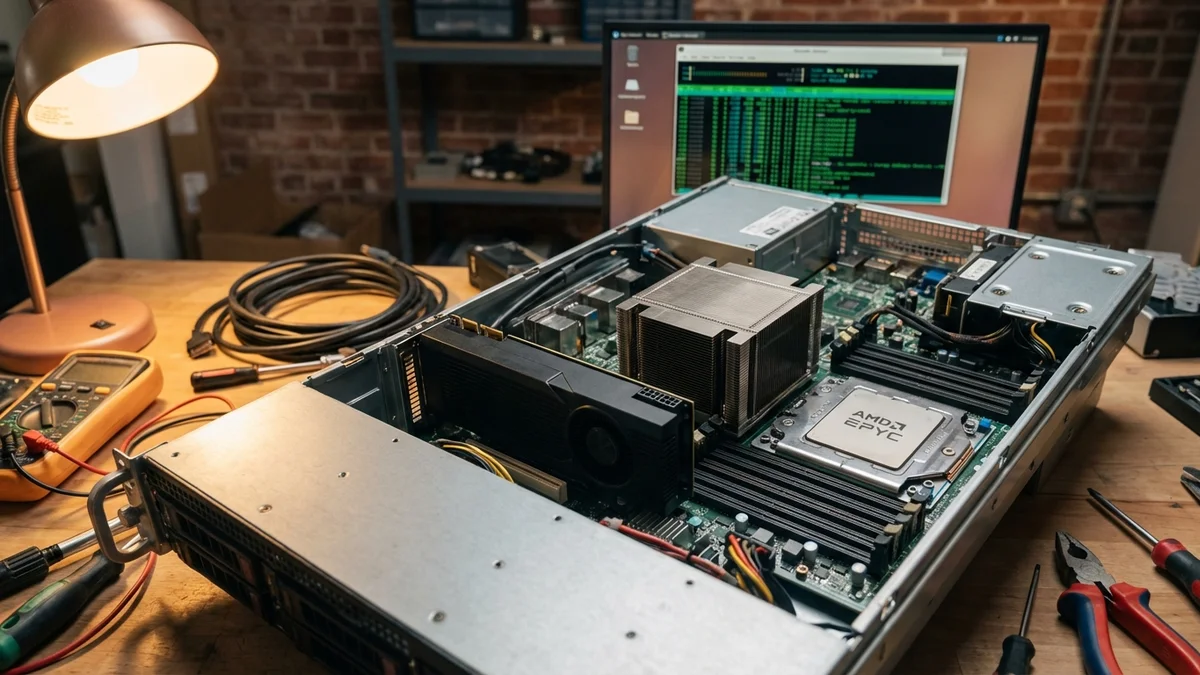
Before we get into the numbers, here's what this benchmark was running on. As of March 23, 2026, these tests used The Rock nightly tarballs for ROCm — not a stable release.
Component
Specification
GPU
1x AMD Mi50 32GB (113-D1631700-111 VBIOS)
CPU
AMD EPYC 7532 (Proxmox VM, 28c/56t)
RAM
128GB DDR4 2933MHz (8x16GB)
OS
Ubuntu Server 24.04, Kernel 6.8.0-106-generic
ROCm
7.13.0a20260321 (The Rock Nightly)
Vulkan
1.4.341.1
llama.cpp
Build 8467
A few things stand out here. The Mi50 is a datacenter GPU — older, sure, but it still packs 32GB of HBM2, which gives it a significant memory advantage over consumer cards. And running inside a Proxmox VM means there's some virtualization overhead, though both backends face the same penalty so the comparison stays fair.
All tests used flash attention (-fa 1) with default f16 cache types via llama-bench. That's a clean, reproducible setup with no exotic flags muddying the water.
The Models: Dense vs. MOE
This benchmark smartly tested both dense and MOE architectures, which turned out to be the single biggest factor in determining a winner between ROCm vs Vulkan in llama.cpp.
The Qwen 3.5 122B test is particularly interesting because it required offloading 28 layers to the CPU. That split GPU/CPU inference scenario is exactly where backend choice becomes critical — it's like testing a relay team versus solo runners.
Prompt Processing: Where Context Length Changes Everything
Here's where the story gets really interesting. Prompt processing — the speed at which the model digests your input before generating a response — shows a clear crossover pattern between the two backends.
Short Context (Under 16K Tokens)
Vulkan is reliably faster on dense models. Both the Qwen 3.5 9B and 27B processed prompts quicker under Vulkan at shorter sequence lengths. If you're having typical back-and-forth conversations that stay under a few thousand tokens, Vulkan gives you noticeably snappier time-to-first-token.
Long Context (16K+ Tokens)
ROCm takes over here. And not by a small margin. According to the benchmark data, Vulkan's prompt processing speed "falls off a cliff" at longer contexts. Those are the original tester's words — and the full dataset backs them up. The prompt processing numbers for Vulkan at depth were described as "bleak."
MOE Models at Any Context Length
ROCm wins regardless of how much text you throw at it. The Qwen 3.5 122B with CPU offloading showed ROCm consistently outperforming Vulkan at every context length tested. So did Nemotron Cascade 2.
Think of it like this: Vulkan is a sprinter — fast out of the gate but can't sustain the pace. ROCm is a marathon runner — slower to warm up but keeps going strong when the workload gets heavy.
So why does this happen? Vulkan is a general-purpose graphics API that happens to support compute workloads. ROCm is AMD's purpose-built compute stack, designed from the ground up for heavy parallel math. At small batch sizes, Vulkan's lower overhead gives it an edge. But as compute demands scale with longer contexts, ROCm's deeper optimization for matrix operations starts to dominate.
Token Generation: Same Pattern, Less Drama
Interesting wrinkle: token generation — the actual output speed you see as the model "types" back at you — follows a similar pattern to prompt processing, but the differences are less dramatic.
All generation tests were standardized at 256 tokens across varying context depths, giving us a consistent comparison point.
Dense models: Vulkan wins again. For the Qwen 3.5 9B and 27B, Vulkan produced tokens faster across the board. And here's the interesting part — the speed difference during generation doesn't decay with depth as sharply as it does during prompt processing. Vulkan keeps its lead more consistently on the generation side.
MOE models and split inference: ROCm wins. If you're running a model that splits work between GPU and CPU — like the 122B Qwen at Q4_0 — ROCm handles that coordination more efficiently.
The key takeaway? For pure generation speed on smaller dense models, Vulkan has a consistent edge. But generation is only half the story. You have to process the prompt before you can generate anything, and that's where ROCm's long-context advantage can make the total experience faster despite slower per-token generation.
ROCm vs Vulkan: Head-to-Head Comparison
Feature
ROCm 7 (Nightly)
Vulkan 1.4.341.1
Short context dense models (<16K)
Slower
Faster
Long context dense models (16K+)
Faster
Much slower
MOE models (any context)
Faster
Slower
Split GPU/CPU inference
Faster
Slower
Stability
Nightly/unstable
Stable release
Setup difficulty
Harder (AMD only)
Easier (cross-vendor)
Hardware support
AMD GPUs only
AMD, NVIDIA, Intel
Price
Free & open-source
Free & open-source
Flash attention
Yes
Yes
Stability: The ROCm Asterisk
And here's the part nobody wants to hear. As of March 23, 2026, the ROCm 7 builds used in this benchmark are nightly prereleases from The Rock. The version tested — 7.13.0a20260321 — isn't a stable release.
The original tester explicitly called this out: "You probably will encounter weird behavior." Whether those bugs come from ROCm itself or from llama.cpp's integration with it isn't always clear. Some users in the thread reported issues with certain model configurations producing incorrect outputs under ROCm nightly, though the benchmark results themselves appeared consistent.
This matters a lot. Raw speed means nothing if your inference setup crashes at 3 AM or silently produces garbage output. For anything resembling a production workload, Vulkan's stability advantage is significant. The Vulkan 1.4.341.1 release used in these tests is mature and well-tested.
Speed with stability beats raw speed every time. If you're running local inference for anything important, test ROCm nightly builds thoroughly before trusting them.
Cost and Setup Complexity
Both ROCm and Vulkan are free and open-source. No licensing costs for either backend. But "free" doesn't mean "equal effort."
Vulkan is easier to get running. It works across AMD, NVIDIA, and Intel GPUs with minimal fuss. Install the Vulkan SDK, build llama.cpp with the Vulkan backend flag, and you're off. The cross-platform support is a genuine advantage (especially if you're experimenting with different hardware or might swap GPUs later).
ROCm only works on AMD GPUs — and not all of them. Installation has historically been painful: driver conflicts, kernel version requirements, and limited distro support have frustrated users for years. The nightly tarballs from The Rock simplify things somewhat, but you're still dealing with AMD's compute ecosystem, which has always trailed NVIDIA's CUDA in developer experience and documentation quality.
As of March 2026, ROCm's hardware support matrix remains narrower than Vulkan's. The Mi50 is well-supported since it's a datacenter part, but if you're running a consumer RX 7000-series card, your mileage with ROCm may vary significantly.
When to Choose Vulkan
Vulkan is the right call if:
You're running dense models under 30B parameters with typical chat-length contexts. The speed advantage at short context is real and consistent.
You want stability above all else. Vulkan is a mature API. No debugging nightly build quirks at midnight.
You're on mixed hardware. Vulkan works on AMD, NVIDIA, and Intel GPUs. One build to rule them all.
You change conversations frequently. Short prompt processing times mean faster context switches between chats.
You're new to local LLM inference. The setup process is simpler and better documented.
When to Choose ROCm
ROCm is the better pick if:
You work with long contexts regularly. Anything beyond 16K tokens and ROCm's prompt processing advantage becomes dominant. Summarizing documents, doing RAG over long retrieval windows, running extended conversations — ROCm saves real time.
You're running MOE models. The Qwen 3.5 122B and Nemotron Cascade 2 results make this crystal clear. MOE architectures perform better on ROCm regardless of context length.
You need split GPU/CPU inference. If your model doesn't fit entirely in VRAM, ROCm handles the GPU-to-CPU handoff more efficiently.
You have an AMD datacenter GPU. Cards like the Mi50, MI100, or MI200 series are ROCm's home turf.
You're comfortable with nightly builds and can tolerate occasional instability for better performance.
What This Means for AMD GPU Owners
The bigger picture here is encouraging for anyone invested in AMD hardware for local AI. A year ago, running llama.cpp on an Mi50 with ROCm was often a frustrating exercise in compatibility troubleshooting. Now we're debating whether ROCm or Vulkan is faster — both work, both are competitive, and the choice comes down to workload fit rather than "does it even run." If you're exploring what to run locally, check our list of the best GGUF models to run locally.
The Rock's nightly builds represent AMD's push to make ROCm more accessible. The fact that a nightly prerelease already outperforms stable Vulkan in most scenarios suggests the stable ROCm 7 release (whenever it arrives) could be a strong default choice for AMD GPU users running local LLMs.
But no sugarcoating — AMD still has ground to cover. NVIDIA's CUDA ecosystem remains the gold standard for GPU compute, and most llama.cpp optimization effort goes toward CUDA first. The ROCm and Vulkan backends both benefit from community effort, but they're playing catch-up in terms of total developer hours invested.
The Final Verdict
This ROCm vs Vulkan llama.cpp benchmark tells a story that doesn't fit into a simple "X is better" answer. But if you pressed me for one?
ROCm 7 wins more scenarios. It takes long-context performance, MOE models, and split inference — that's three of the four major categories tested. Vulkan wins short-context dense inference convincingly, but that's the narrower use case for anyone pushing their Mi50 with serious workloads.
The real question is whether you can tolerate ROCm's current instability. A personal chatbot where occasional weirdness is annoying but not catastrophic? Give ROCm nightly a shot. A local inference server handling real workloads where reliability matters? Wait for stable ROCm 7 or stick with Vulkan.
Either way, the AMD local inference story keeps getting better. And that's good news for everyone who doesn't want to pay the NVIDIA tax.
Yes, Vulkan is a cross-platform graphics and compute API that works on AMD, NVIDIA, and Intel GPUs. This makes it the most portable backend option for llama.cpp. NVIDIA users can choose between CUDA (best performance), Vulkan (cross-platform), or other backends depending on their needs.
What AMD GPUs are supported by ROCm 7?
ROCm 7 officially supports AMD Instinct datacenter GPUs (Mi50, MI100, MI200, MI300 series) and select Radeon Pro cards. Consumer Radeon RX 7000-series GPUs have limited and unofficial ROCm support — some users report success, but compatibility varies by specific model and Linux kernel version. Check AMD's official ROCm compatibility matrix before purchasing hardware.
How much VRAM does Qwen 3.5 122B Q4_0 require?
At Q4_0 quantization, Qwen 3.5 122B requires roughly 61GB of memory for weights alone, plus additional memory for KV cache during inference. This far exceeds the Mi50's 32GB HBM2, which is why the benchmark offloaded 28 layers to system RAM. You'd need at least two Mi50 cards or a single MI100/MI200 to run it fully on GPU.
When will stable ROCm 7 be released?
As of March 2026, AMD has not announced a firm release date for stable ROCm 7. The nightly builds from TheRock (version 7.13.0a tested in this benchmark) are available for testing but are explicitly marked as unstable. Monitor AMD's ROCm GitHub repository and release notes for stable version announcements.
Can I switch between ROCm and Vulkan backends without rebuilding llama.cpp?
No, you need to rebuild llama.cpp with the appropriate backend flag for each. The build process uses different CMake flags — typically GGML_HIP=ON for ROCm and GGML_VULKAN=ON for Vulkan. However, you can maintain two separate build directories on the same system and switch between them without reinstalling drivers, since ROCm and Vulkan can coexist.