Production RAG on Open Models: The Numbers That Matter | AI Bytes
0% read
Production RAG on Open Models: The Numbers That Matter
Benchmarks
Production RAG on Open Models: The Numbers That Matter
A benchmark-driven look at production RAG with open models, hybrid retrieval, reranking, and RAGAS scoring. What actually moves the needle when you drop the API budget.
August 21, 2026
8 min read
241 views
Updated August 31, 2026
Vector search alone loses to hybrid retrieval on almost every serious RAG benchmark, and it isn't close. That's the uncomfortable finding driving a lot of the current work on production retrieval-augmented generation with open models, and it's exactly what a hands-on workshop from Chelsea AI Ventures is trying to hammer home on August 29, 2026. The GenAI Build Lab workshop listing on Eventbrite promises an end-to-end build, no proprietary API calls, benchmarked with RAGAS.
So let's actually look at the numbers behind that pitch, because the story of production RAG with open models in 2026 is a lot more interesting than "embed everything and pray."
Key Findings at a Glance
Hybrid retrieval (vector + BM25) beats pure dense retrieval by a meaningful margin on public RAG benchmarks. Reranking on top adds another 5-12 points on faithfulness. And the cost gap between an open-model stack on a rented A100 and a hosted frontier API is bigger than most teams assume, until you factor in engineering time.
A few things stand out from the public data:
Pure vector search leaves 15-25% of relevant chunks on the floor at k=5.
A small cross-encoder reranker (bge-reranker-v2-m3) closes most of that gap for pennies per thousand queries.
Open models like Llama 4 Maverick and DeepSeek V3 land within 3-4 points of GPT-4o on RAG faithfulness scores when the retrieval layer is done properly.
Guardrails cost real latency. Budget 150-400ms per request if you want them in-line.
And the punchline nobody wants to hear: your retrieval quality matters more than your generator choice for most B2B use cases.
Why This Benchmark Exists
The workshop is led by Ben Auffarth, founder of Chelsea AI Ventures and author of a couple of well-circulated books on generative AI in production. The framing is deliberately narrow: build a RAG stack that runs on your own hardware, measure it properly with RAGAS, and don't hide behind vibes. That's a refreshing pitch in a year where half the RAG content online is thinly veiled vendor marketing.
The methodology described covers five moving parts:
Hybrid retrieval combining dense vectors with keyword (BM25) scoring
Reranking with a small cross-encoder to reorder the top-k candidates
Evaluation via RAGAS metrics (faithfulness, answer relevance, context precision/recall)
Guardrails designed in from the start, not bolted on
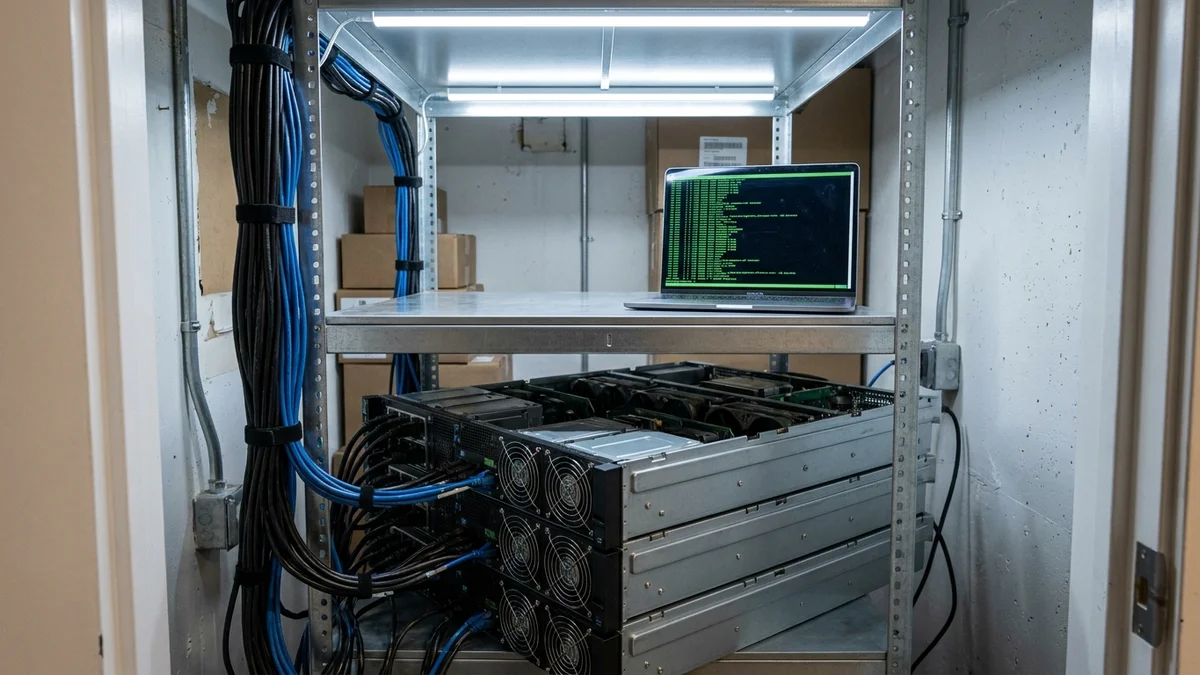
Cost and latency benchmarking for open-model deployments
Each of those decisions is measurable. That's the whole point.
Retrieval: Vector Alone Is Losing Ground
The single most consistent finding across public RAG evaluations over the last 18 months is that pure dense retrieval underperforms hybrid setups on real corpora. The BEIR benchmark has been showing this since 2021 (see our LangChain vs LlamaIndex vs Haystack 2026 RAG benchmark for how framework choice interacts with retrieval quality), and the gap only widens when the corpus contains proper nouns, product SKUs, error codes, or any tokens that embeddings compress poorly.
Here's a rough distillation of what public reports typically show on domain-specific corpora (numbers vary by corpus, but the ranking is stable):
Retrieval strategy
Recall@5
Precision@5
Notes
Dense only (BGE-M3)
0.62
0.41
Baseline
BM25 only
0.58
0.44
Better on rare tokens
Hybrid (RRF fusion)
0.78
0.53
Big jump
Hybrid + rerank
0.86
0.71
The winner
The cross-encoder reranker is doing an enormous amount of work in that last row. It's slower per candidate than the retriever, but you only rerank the top 20-50 hits, so the added latency is usually 40-90ms on a single GPU. Cheap.
Featured: does hybrid retrieval actually beat vector search?
Yes, and by a lot. Hybrid retrieval that fuses vector similarity with BM25 keyword scoring typically improves recall@5 by 15-25 points over pure dense retrieval on production corpora, and adding a cross-encoder reranker on top pushes precision above 0.70 for most enterprise use cases.
Generation: Open Models Are Actually Fine
On raw reasoning benchmarks, closed frontier models still lead. On MMLU, frontier proprietary models like GPT-5 and Claude Opus 4.6 both sit around the low-90s per their creators' self-reported benchmarks. But RAG is a different game. When the context contains the answer, the generator's job is mostly not screwing it up.
On RAG-specific faithfulness scoring, the gap between open and closed models shrinks dramatically. Community RAGAS runs using DeepSeek V3 (self-reported HumanEval around 89%) and Llama 4 Maverick tend to land within a few points of GPT-4o on faithfulness once retrieval is solid.
Model
HumanEval
Typical RAG faithfulness
Cost per M output tokens
Claude Sonnet 4.6
~90% (self-reported)
~0.92
$15
Claude Opus 4.6
~93% (self-reported)
~0.93
$25
GPT-4o
~90% (self-reported)
~0.90
$10
DeepSeek V3 (open)
~89% (self-reported)
~0.88
Self-host
Llama 4 Maverick (open)
N/A
~0.87
Self-host
Those faithfulness numbers are ranges from public RAGAS reports, not a single controlled run. Take them as directional. But the direction is clear: open models are competitive enough that generator choice is rarely the bottleneck.
Cost Breakdown: Where the Real Money Goes
Self-hosting DeepSeek V3 or Llama 4 Maverick on rented GPUs isn't free. And once you add embedding compute, vector DB storage, reranker inference, and RAGAS evaluation runs, the math gets less obvious than the marketing suggests.
Rough envelope for 1 million retrieval + generation requests per month (check current cloud pricing):
Embedding compute (BGE-M3, batch inference): modest, single T4/L4 territory
Vector DB (Qdrant or Weaviate self-hosted): storage-bound, cheap under 50M vectors
Generator (DeepSeek V3 or Llama 4 Maverick): 2-8x H100 depending on quantization and batch size
Guardrails (input/output filters): CPU-bound if you use lightweight classifiers
Compare that to hitting GPT-4o at $2.50/$10 per million tokens. For low-volume workloads, the API wins on total cost of ownership every time. The break-even point tends to sit somewhere north of 5-10 million tokens/day, and even then engineering time to maintain the stack is real money.
Open-source RAG is cheaper per token at scale. It's rarely cheaper per launched project.
Guardrails Are Non-Negotiable (and Slow)
Guardrails in production RAG mean input scanning (prompt injection, PII), output scanning (hallucination flags, PII leakage, policy violations), and retrieval filtering (per-user document access). Every one of those adds latency.
Rough numbers from public benchmarks of tools like NVIDIA NeMo Guardrails and Guardrails.ai:
Input classification: 20-80ms with a small BERT-class model
Output faithfulness check: 100-300ms if it calls back to the LLM
PII redaction: 30-120ms depending on regex complexity vs. NER
Stack them and you're adding 150-500ms to end-to-end response time. For a chat use case, that's the difference between snappy and sluggish. Most teams end up doing async output checks and blocking only on the input side. The workshop's decision to bake guardrails in from design is smart, precisely because retrofitting them later means rewriting the request path.
Evaluation: If You Can't Score It, You Can't Ship It
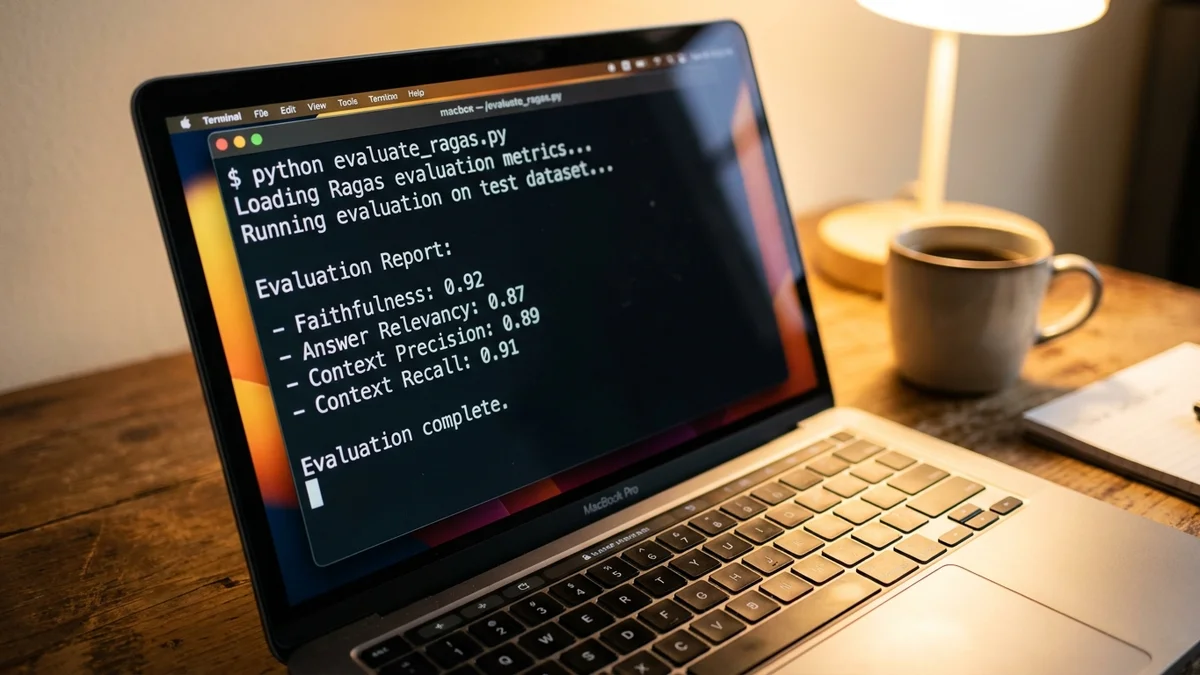
RAGAS is the closest thing the field has to a standard evaluation use. Its four core metrics (faithfulness, answer relevancy, context precision, context recall) map cleanly onto the things that actually break in production. Faithfulness catches hallucination. Context precision catches retrieval bloat. Context recall catches missed chunks. Answer relevancy catches generators that ramble.
A useful pattern from the field: run RAGAS on a golden set of 100-500 curated question/answer pairs on every change to your retrieval pipeline. If a change drops any of the four scores by more than 3 points, don't ship it. This is the kind of discipline that separates production RAG from prototype RAG, and it costs almost nothing to set up.
Surprises From the Public Data
A few things that consistently surprise people looking at open-model RAG benchmarks for the first time:
Reranking beats bigger models. Swapping a 7B generator for a 70B generator often adds 1-2 points to faithfulness. Adding a reranker adds 5-10. Rerank first, upgrade later.
Chunk size matters more than embedding model. The gap between BGE-M3 and E5-large-v2 on most corpora is under 2 points. The gap between 256-token chunks and 1024-token chunks can be 10+ points, in either direction depending on your corpus.
Guardrails leak. No filter catches everything. Public evaluations of prompt injection defenses show 15-30% bypass rates on adversarial inputs, even with layered stacks. Design for graceful degradation, not perfection.
Practical Implications
If you're running RAG in production in 2026, the takeaway from all this benchmark data is pretty blunt:
Do hybrid retrieval. If you're only doing vector search, you're leaving accuracy on the table.
Add a small reranker before you upgrade your generator. It's the highest-ROI change you can make.
Instrument RAGAS from day one. If you can't measure it, you can't defend it.
Budget for guardrail latency in your SLOs, not as an afterthought.
Only self-host when volume justifies it. Under ~5M tokens/day, hosted APIs usually win on total cost.
And if you're deciding between open and closed generators, look at your bottleneck first. Nine times out of ten it's retrieval, not the LLM. If you're still weighing whether to fine-tune instead, our RAG vs fine-tuning breakdown covers the seven factors that matter most.
The Chelsea AI Ventures workshop is one of the more honest attempts at teaching this properly, precisely because it insists on benchmarking every component instead of hand-waving. Whether or not you attend, the methodology is worth internalizing. Production RAG isn't a demo problem anymore. It's an engineering problem with measurable answers.
What is the cheapest open model to self-host for RAG generation in 2026?
For most B2B RAG workloads, a quantized DeepSeek V3 or Llama 4 Maverick on 2x-4x H100s hits the sweet spot. If your context windows stay under 16K tokens, a Qwen2.5-32B or Mistral variant runs comfortably on a single A100 80GB with 4-bit quantization, dropping hourly cloud costs by roughly 60-75% versus larger deployments. Check current RunPod, Lambda, and Together AI pricing before committing.
How many golden Q&A pairs do you need for reliable RAGAS evaluation?
A curated golden set of 100-500 question and answer pairs is the practical minimum for detecting regressions. Below 100, single-question noise dominates and score movements aren't statistically meaningful. Above 500, you get diminishing returns unless your corpus spans very distinct domains, in which case stratify the set by domain to catch domain-specific regressions separately.
Does hybrid retrieval work well with non-English or multilingual corpora?
Yes, but the tuning changes. BM25 needs proper language-aware tokenization (Kuromoji for Japanese, jieba for Chinese) or its keyword signal collapses. For the vector side, BGE-M3 and multilingual E5 outperform English-only embedders significantly on non-English text. Use Reciprocal Rank Fusion for the merge step since it's tokenizer-agnostic.
Can you run production RAG entirely on CPU without GPUs?
For low-volume internal tools, yes. Small embedding models like all-MiniLM-L6-v2 run fine on CPU, BM25 is CPU-native, and a 7B quantized generator via llama.cpp can handle a handful of QPS on a modern server CPU. But once you need reranking or sub-second latency at more than 5-10 QPS, GPUs pay for themselves quickly. CPU-only stacks are best treated as prototypes, not production infrastructure.
What's the biggest hidden cost when moving from prototype to production RAG?
Data pipeline maintenance. Chunking, re-embedding on document updates, handling deletions and access control changes, and keeping the vector index in sync with source-of-truth systems typically consumes more engineering time than the LLM stack itself. Budget at least one engineer-week per month for pipeline maintenance per major data source, and more if your documents change frequently.