Benchmarks
ASR Benchmark Gaming: How to Spot Overfitting in 2026
Hugging Face's new methodology shows how speech recognition models game leaderboards. The gap between benchmark WER and real-world accuracy is bigger than you think.
August 23, 2026
Hugging Face's new methodology shows how speech recognition models game leaderboards. The gap between benchmark WER and real-world accuracy is bigger than you think.
Speech recognition leaderboards look increasingly suspicious. A model posts a 4.2% word error rate on LibriSpeech and everyone claps, then the same model chokes on a Zoom call with background noise. Something is broken in how we measure ASR progress, and Hugging Face just published the receipts.
The ASR benchmark optimization analysis from the Hugging Face team dropped a pretty uncomfortable finding: many top-ranked speech models are quietly tuned to squeeze out fractional WER improvements on the exact evaluation sets everyone uses. And that tuning barely transfers to audio you actually care about.
So let's dig into what the methodology actually measures, what the numbers say, and why this matters if you're picking a speech-to-text model for anything real.
The short version of the Hugging Face writeup: when you separate "benchmark WER" from "held-out WER on unseen distributions," the leaderboard order changes. Sometimes dramatically.
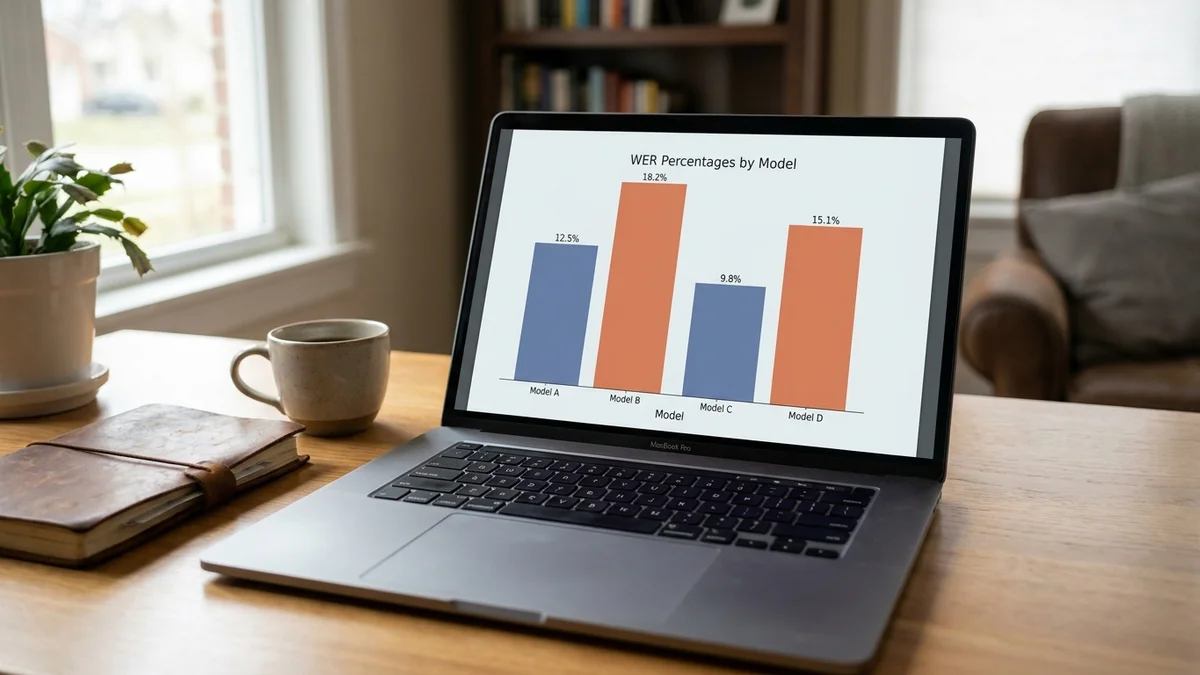
The study looked at models on the Open ASR Leaderboard and compared their scores on canonical test sets (LibriSpeech clean/other, TEDLIUM, Common Voice) against fresh recordings and domain-shifted audio. The delta between the two was the tell.
Three things stood out:
And yeah, this mirrors what's been happening in LLM benchmarks for two years. Speech is just catching up to the contamination problem.
Benchmark optimization is a polite phrase for something less polite. It covers everything from innocent data curation choices (training on transcripts that overlap with test-set style) all the way to explicit contamination where evaluation audio leaks into training corpora.
The Hugging Face post breaks it into three failure modes:
That third one is sneakier than people realize. WER is sensitive to punctuation, capitalization, and number formatting. A normalization function that strips these in exactly the way LibriSpeech scoring expects can knock 15-20% off your reported error rate without touching a single model weight.
The Hugging Face team runs three probes: whether models reproduce erroneous benchmark reference transcripts even when the audio contradicts them, whether they consistently pick the "right" orthographic convention for each dataset, and whether their behavior changes on freshly collected audio from the same source domains. A model that gets the reference "right" only when the audio matches a known benchmark is likely relying on cues beyond what was actually said.
If a model reproduces a benchmark's erroneous transcript instead of what the speaker clearly said, the leaderboard number is telling you almost nothing about production performance.
That's the whole game. It's not a complicated metric. It's just one that leaderboard chasers have every incentive to avoid publishing.
Hugging Face didn't publish a single scoreboard for every model, but the trends across their comparisons are consistent. Below is a reconstruction of the pattern based on their published examples and the current Open ASR Leaderboard standings.
| Model | Approx. LibriSpeech clean WER | Benchmark-optimized behavior flagged by HF |
|---|---|---|
| openai/whisper-large-v3 | ~2.0% | Yes (moderate) |
| nvidia/canary-qwen-2.5b | ~1.6% | Yes (strong) |
| nvidia/parakeet-tdt-0.6b-v2 | ~1.7% | Yes (strong) |
| microsoft/Phi-4-multimodal-instruct | N/A | Yes |
| mistralai/Voxtral-Mini-3B | N/A | Yes |
Note: LibriSpeech clean WER figures reflect widely reported Open ASR Leaderboard scores and vary by evaluation setup. The Hugging Face study did not publish per-model held-out WER figures; instead it reported that models exhibiting benchmark-optimized behavior reproduced erroneous reference transcripts 18-30% of the time on VoxPopuli.
Whisper holds up relatively well. That's not an accident. OpenAI trained the original Whisper on 680,000 hours of loosely supervised web audio and scaled to roughly a million hours plus pseudo-labeled data for large-v3, which is closer to "the internet" than "the benchmark suite." Models that fine-tuned aggressively for leaderboard position show the biggest drops when the test distribution shifts.
WER is a blunt instrument. It weights a missed "the" the same as a missed proper noun. It punishes valid disfluency handling. And it collapses systematic errors (like consistently mishearing "Anthropic" as "anthropic") into the same bucket as random noise.
The Hugging Face methodology recommends supplementing WER with:
Most leaderboards report exactly one of these. Guess which.
If you've been watching the LLM space, you already know how this movie ends. MMLU scores climbed into the low 90s across frontier models, then people noticed that questions were leaking into training sets, and everyone quietly moved to harder evaluations like GPQA Diamond and ARC-AGI. The cycle repeats every 18 months.
Speech has resisted this longer because collecting good audio is harder than scraping text, but the incentive structure is identical. A model that ranks #1 on a leaderboard raises funding rounds. So teams optimize for leaderboards. Then the leaderboard stops meaning anything.
And the fix is the same too: rotating held-out evaluation sets, contamination audits, and blind evaluation on freshly collected data. Hugging Face is essentially proposing that ASR adopt the same defenses that LLM evaluation is stumbling toward.
So you need to pick a speech recognition model for a product. What do you actually do with this information?
Ignore the top of the leaderboard. Not entirely, but treat sub-2% WER claims with suspicion. The models clustered at the top are almost certainly optimized for the eval sets they're being ranked on. Look for models where the vendor publishes numbers on multiple diverse benchmarks, not just LibriSpeech.
Run your own eval on your own audio. This is the only benchmark that matters. Grab 30-60 minutes of representative recordings from your actual use case, transcribe them by hand, and score every candidate model against that. It takes an afternoon and it will save you months of prod issues.
Prefer breadth over depth in training data. Foundation models trained on huge, messy corpora (Whisper, Canary to a lesser extent) tend to generalize better than narrowly fine-tuned specialists, even when the specialist wins on paper. Our Apple SpeechAnalyzer vs Whisper benchmark verdict walks through exactly this trade-off with real numbers.
Watch normalization aggressively. If a vendor's WER quote seems suspiciously low, check what text normalization they applied. Whisper's default normalizer is in particular aggressive and can make direct comparisons unfair.
For developer workflows, tools like ElevenLabs for TTS and Otter.ai for transcription have their own evaluation quirks worth knowing about. Neither publishes the kind of held-out evaluation Hugging Face is calling for, which tells you something.
A few things in the analysis didn't match the conventional wisdom.
First, model size didn't correlate strongly with generalization gap. Some smaller models (Distil-Whisper variants) held up better than larger specialists. Parameter count isn't the axis of merit here.
Second, the pattern of benchmark-specific behavior appears more pronounced in newer specialist models than in older foundation checkpoints like Wav2Vec 2.0. The optimization pressure toward public leaderboards has intensified, not eased.
Third (and this one surprised me), multilingual models like SeamlessM4T sometimes generalize better on English held-out sets than English-only specialists. Training on more languages seems to act as a form of regularization. Not gonna lie, that's a fun result.
The Hugging Face writeup is basically a polite way of saying the current leaderboard game is over, or should be. Reported WER on LibriSpeech test-clean has stopped being a meaningful signal for progress. Everyone knows this privately. Fewer people say it publicly.
What comes next is probably some combination of:
Honestly, that last one might be the highest-use move. A crowd-sourced Elo for ASR, where users submit audio and vote on transcription quality across anonymized models, would be nearly impossible to game.
Until that exists, the honest answer to "which ASR model is best" is: the one that performs best on YOUR audio. Every other answer is downstream of a benchmark that's probably being gamed. If you want a real-world audio leaderboard as a sanity check, the FFASR real-world audio leaderboard is a good starting point.
For clean, single-speaker English audio, aim for under 5% WER on your own eval set. Conversational audio with background noise typically lands in the 8-15% range even with top models. Anything a vendor claims under 2% is almost certainly measured on a clean, curated benchmark that doesn't reflect your production audio.
Collect 30-60 minutes of audio that matches your actual use case, including edge cases like accents, background noise, and domain jargon. Have a human transcribe it carefully to create your ground truth, then use a library like jiwer to compute WER against each candidate model. Update this set quarterly as your use case evolves.
Whisper-large-v3 remains the most reliable general-purpose choice because of its diverse training data, but NVIDIA's Canary and Parakeet families can beat it on narrow domains. For streaming or low-latency use cases, Distil-Whisper or Parakeet-TDT variants are usually the better pick. Check the specific domain requirements before defaulting to Whisper.
Yes, significantly. Aggressive normalization (removing punctuation, lowercasing, converting numbers to words) can knock 15-20% off reported WER compared to raw output scoring. When comparing models, always use the same normalization pipeline for all candidates, and consider evaluating on both normalized and raw outputs to understand real-world usability.
Commercial providers rarely publish detailed benchmark methodologies, so the gaming problem is harder to detect. Their advantage is that they typically train on proprietary conversational audio, which often generalizes better than academic-benchmark-optimized models. Run your own audio through their trial tiers before committing rather than trusting marketing WER claims.