Real-SWE Benchmark: AI Models Struggle on Private Code | AI Bytes
0% read
Real-SWE Benchmark: AI Models Struggle on Private Code
Benchmarks
Real-SWE Benchmark: AI Models Struggle on Private Code
Real-SWE tests AI models on private enterprise codebases instead of public GitHub repos. The top frontier model scores 38.8%, exposing how far benchmark hype is from production reality.
September 14, 2026
7 min read
39 views
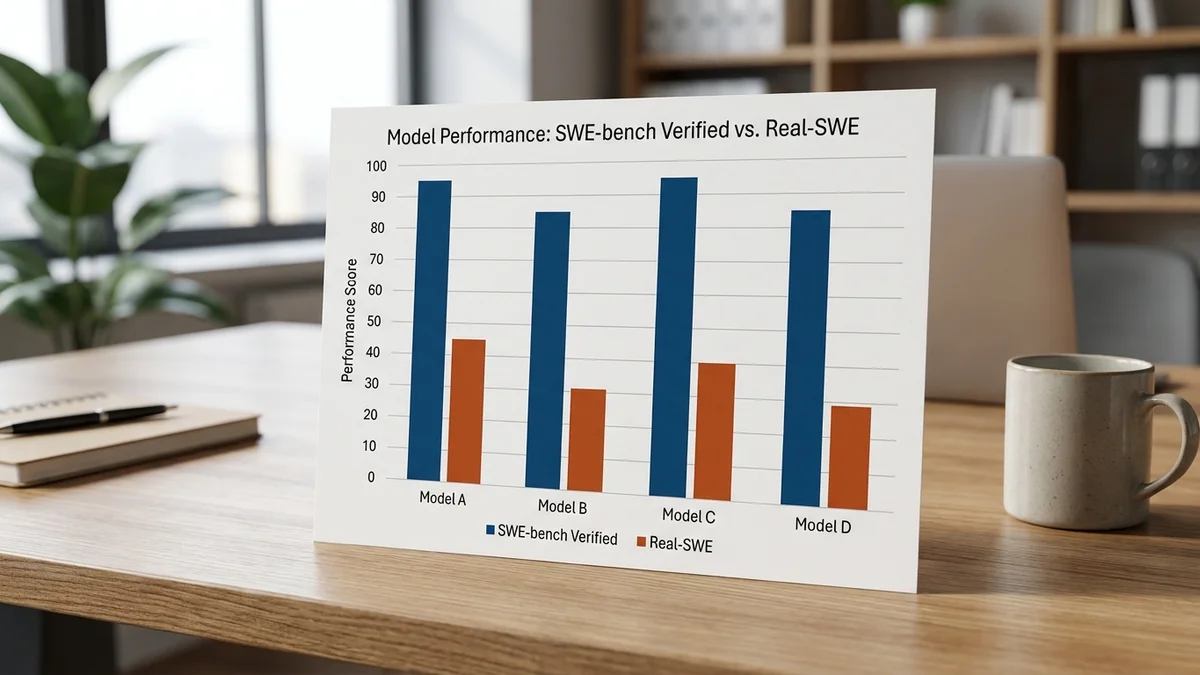
Public benchmarks make AI coding models look almost superhuman. Frontier models routinely score above 90% on SWE-bench Verified. And yet, if you've actually shipped one of these agents into a real enterprise repo, you already know the truth: the scores don't survive contact with production code.
That gap is what the new Real-SWE benchmark from Specific is trying to measure. Instead of testing models on scrubbed, public GitHub issues that have almost certainly leaked into training data, Real-SWE runs frontier models against private, real-world enterprise codebases licensed from partner companies. The result is the first benchmark that reflects what engineering leaders have been saying quietly for a year now.
The scores drop. A lot.
What Real-SWE Actually Measures
The Real-SWE benchmark is a coding evaluation that runs AI models against private, production-grade enterprise repositories rather than public open-source projects. It uses real bug tickets, real pull request histories, and real reviewers from participating companies, which makes contamination from pretraining data effectively impossible.
Each task is drawn from an actual closed PR at a partner company. The model gets the ticket description, access to the repo, and a validation suite that mirrors the company's own CI. A task counts as "resolved" only if the patch passes the exact test the human engineer's patch had to pass. No shortcuts.
That's a much harder bar than SWE-bench Verified, which pulls from a set of well-known Python repos like django, sympy, and astropy. Those repos have been sitting on GitHub for a decade. Anything you've read about, the model has probably read too.
The Methodology Break From SWE-bench
Specific's setup differs from SWE-bench in several ways worth understanding before you read the numbers.
First, the codebases are polyglot. Real enterprise stacks are TypeScript + Go + a legacy Java service + some Python glue. Public benchmarks are almost entirely Python. So a model that memorized every Python idiom on GitHub loses that advantage immediately.
Second, the tasks are cross-cutting. Reference solutions on Real-SWE edit a median of 11 files per task, compared with 6 files for FrontierCode and DeepSWE, according to Specific's published comparison. A single change routinely spans multiple parts of the application.
Third, there's no cached test suite. The model has to figure out how to run the tests, which in a real repo often means reading an internal Makefile, a Bazel target, or a badly documented Docker script. This alone kills a lot of agents.
The Results Are Rough
Based on the leaderboard published by Specific in September 2026, here's how the top frontier model-and-harness combinations scored on Real-SWE.
Rank
Model
Harness
Resolution Rate
1
Fable 5.1
Claude Code
38.8%
2
GPT-6 Astra
Codex CLI
33.8%
3
Gemini 3.8 Flash
Gemini CLI
31.2%
4
GLM 5.3
Claude Code
28.8%
=5
Grok 4.6
Grok Build
23.8%
=5
Muse Spark 1.3
Muse Code
23.8%
7
Kimi K3
Kimi Code
18.8%
8
GPT-5.6 Sol
Codex CLI
16.2%
Resolution rate is equivalent to pass@1, averaged over eight independent runs per task, according to Specific.
The top score is under 40%. Compare that to the 90%+ numbers these same model families post on SWE-bench Verified and the gap is stark. Whatever the public scores are measuring, it isn't quite the same skill.
And look at GPT-5.6 Sol, the wooden-spoon finisher at 16.2%. The very lineage that dominates on synthetic benchmarks lands at the bottom on real code. Model families do not translate cleanly from public leaderboards to private production.
Where The Models Actually Failed
Specific published a failure taxonomy alongside the scores, and this is the part worth reading twice. The failure modes aren't what you'd expect from a benchmark leaderboard.
Specific groups every failed rollout into one of five categories:
Missed requirement. The model leaves out behavior the instruction explicitly asks for. This is the most common failure mode across nearly every model. Grok 4.6 fails this way 67.2% of the time, Kimi K3 53.8%.
Unverified assumption. The model builds on a guess about the system instead of checking it in the workspace. GPT-5.6 Sol shows this failure most often (43.3% of its failed runs).
Integration error. The model has the right idea but wires it into the surrounding system incorrectly. Gemini 3.8 Flash fails this way 49.1% of the time.
Regression. The patch breaks existing behavior while making the change. Rare across the leaderboard, but still nonzero for most models.
Wrong file. The model delivers the change somewhere the running application never calls, like a one-off script. GLM 5.3 and Kimi K3 are the only models with more than 3% of failures in this bucket.
None of these are "the model couldn't solve the problem." They're operational failures rooted in poor context grounding. That's a big deal.
The Surprises
A few results genuinely didn't line up with expectations.
Fable 5.1's lead is surprisingly narrow. The top model tops out at 38.8%, and the second-place model (GPT-6 Astra) is only five points behind. On public benchmarks that are asymptotically pinned near 96%, the margins look enormous. On real code, the frontier is bunched.
Cost doesn't buy accuracy. Specific reports estimated per-rollout costs ranging from $2.50 (Gemini 3.8 Flash) to $6.96 (Fable 5.1). Gemini 3.8 Flash lands third overall at $2.50 per rollout, ahead of models costing twice as much. Not gonna lie, this changes the price-per-fix math a lot compared to public benchmark leaderboards. Engineers on Claude Code and other harnesses have been reporting similar patterns for months.
Some tasks nobody solved. On the "Analytics stream reducer" sample task, every model went 0/8. On "Tax jurisdiction," resolution rate across all models was 3.1%. Six of ten sample tasks resolved below 15%. Frontier models remain very weak on multi-service, business-logic-heavy work.
Why Public Benchmarks Overstate Performance
There are basically three reasons the public numbers are inflated, and Real-SWE isolates each one.
Contamination is the obvious one. If a model saw the fix for a django issue during pretraining, resolving that issue at inference is closer to retrieval than reasoning. Independent researchers have documented contamination issues in SWE-bench since 2024.
The second reason is that public benchmarks reward narrow file-level fixes. Real-SWE requires reference-quality patches, and Specific classifies "wrong file" and "missed requirement" outcomes as failures even when a naive test might have passed.
The third reason is tooling. Every serious agent framework, Claude Code, Devin, Aider, has been tuned against SWE-bench Verified. That tuning doesn't generalize to unfamiliar codebases the frameworks never saw during optimization.
What This Means For Engineering Teams
If you're an engineering lead deciding whether to put an AI coding agent on your production repo, the practical takeaway is pretty clear. Frontier models are useful, but the SWE-bench numbers you saw in the marketing deck are lying to you. Budget accordingly.
The gap between benchmark performance and production performance is now the single most important metric in AI coding, and almost no one publishes it.
A few concrete implications:
Expect 15-40% task completion, not 90%+. On non-trivial private code, even the top model resolves fewer than four in ten real tickets end-to-end.
Invest in environment tooling before you invest in agents. Specific found that 71.4% of rollouts under 10 minutes failed. Good justfile or Makefile conventions won't rescue every task, but a codebase where the model can't even run the tests is one where no agent will succeed.
Assume multi-service work still needs a human driver. Six of ten sample tasks resolved below 15% across all models. Complex refactors aren't going to work autonomously. Not in 2026, based on this data.
Cost matters more, not less, at these accuracy levels. If you're only going to get 30-40% of tasks done, paying twice as much per rollout for a marginal accuracy gain looks a lot worse than it does at 96% accuracy.
Specific plans to update the leaderboard as new models ship and to add participating companies over time. If the methodology holds up, this becomes the benchmark that matters for anyone actually shipping AI-authored code. The public ones will still get the marketing screenshots. But engineering decisions should start weighting Real-SWE more heavily than SWE-bench Verified.
And for what it's worth, the honest scores are more useful anyway. A benchmark that says "the best model gets 38.8%" is planning-actionable. A benchmark that says "96%" just makes your Slack full of hype threads.
How can I get my company's codebase included in the Real-SWE benchmark?
Specific licenses private codebases from partner companies for Real-SWE tasks. There is no public application form listed on the benchmark page; interested companies typically reach out to Specific directly to discuss participation. Task selection prioritizes real production workloads with substantial engineering teams and business consequences.
Does Real-SWE support languages other than Python and JavaScript?
Yes. Specific's task environments include Go, Python, Node.js, TypeScript, and multiple databases (PostgreSQL, MySQL, MongoDB, Redis). This is one of the main methodological differences from SWE-bench, which is almost entirely Python-based and does not reflect polyglot enterprise stacks.
Which AI coding agent should I use if my repo is large and messy?
Based on the September 2026 Real-SWE leaderboard, Fable 5.1 driven through Claude Code was the top performer at 38.8% resolution rate, followed by GPT-6 Astra on Codex CLI at 33.8%. If cost is a factor, Gemini 3.8 Flash on Gemini CLI landed third at 31.2% for the lowest per-rollout price on the board. Real-SWE evaluates model-and-harness combinations rather than models in isolation, so the harness you choose matters.
How often is the Real-SWE leaderboard updated?
Specific has not published a fixed update cadence. The September 2026 release is the initial leaderboard; the benchmark page indicates additional companies and models will be added over time. Watch the Specific benchmarks page for updates.
Is there any way to reproduce Real-SWE results without partner access?
Not fully, because the underlying repos are private. But Specific publishes per-task pass/fail rates, per-model failure taxonomies, cost estimates, and sample task descriptions, which is enough to validate the leaderboard ordering. For open reproduction, the closest public analogs are polyglot benchmarks like Terminal-Bench and FrontierSWE, though they still tend to overstate model performance relative to real enterprise work.