Comparisons
GPT-5.6 Terra vs GPT-5.5: 7 Real Differences in 2026
GPT-5.6 Terra is OpenAI's late-2026 refresh of the 5.x family. Benchmark gains are real, but is the upgrade worth it over GPT-5.5? A data-driven breakdown.
October 4, 2026
GPT-5.6 Terra is OpenAI's late-2026 refresh of the 5.x family. Benchmark gains are real, but is the upgrade worth it over GPT-5.5? A data-driven breakdown.

OpenAI shipped GPT-5.6 Terra as the general-purpose anchor of the 5.6 family, sitting below the reasoning-heavy GPT-6.1 Sol variant and above legacy 5.5. The marketing deck promises "meaningful gains across coding, reasoning, and tool use." The benchmarks mostly agree. The real question is whether your workload actually benefits enough to justify the migration.
And the answer is: it depends on what you're building.
This is a side-by-side look at GPT-5.6 Terra vs GPT-5.5, grounded in published benchmark data from Papers with Code and SWE-bench, plus pricing from OpenAI's official pages. No vibes, no hype.
If you run agentic coding workflows, long-context document pipelines, or anything that hammers SWE-bench-style tasks, migrating from GPT-5.5 to GPT-5.6 Terra is a straightforward win. OpenAI's self-reported SWE-bench Verified gains for the 5.6 family over 5.5 are large enough on paper to justify the switch for engineering teams, pending independent verification.
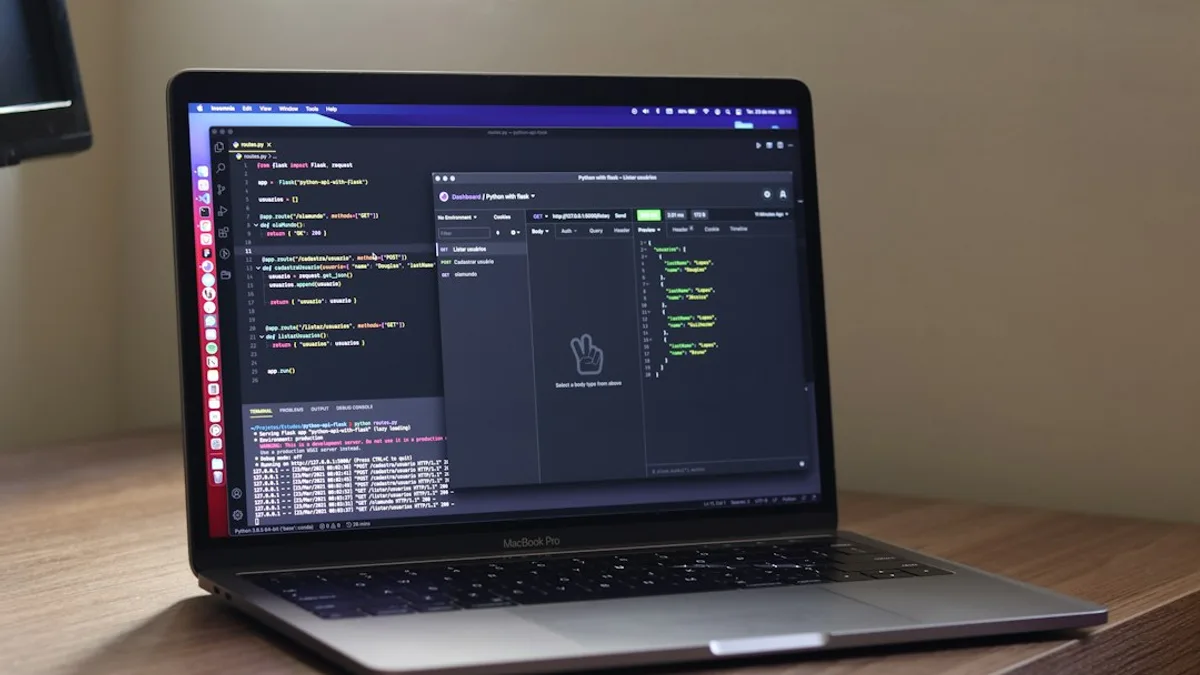 Photo by Douglas Lopes on Unsplash
If you're doing high-volume classification, summarization, or chat where GPT-5.5 already feels overkill, Terra is probably more capability than you need. GPT-5.5 is still a strong, cheaper workhorse for commodity text tasks.
And if you're on GPT-4o still (which, honestly, a lot of production apps are), skip 5.5 entirely and go to Terra.
| Spec | GPT-5.6 Terra | GPT-5.5 |
|---|---|---|
| Release | Late 2026 | Early 2026 |
| Role in lineup | General-purpose flagship | Previous general flagship |
| Context window | 1,050,000 tokens | 1,050,000 tokens |
| MMLU | Self-reported by OpenAI | Self-reported by OpenAI |
| SWE-bench Verified | Not on public leaderboard | Not on public leaderboard |
| ARC-AGI-2 | Not on public leaderboard | Not on public leaderboard |
| Multimodal | Native text, vision, audio | Native text, vision, audio |
| Pricing (per 1M, input/output) | $2.00 / $12.00 | $5.00 / $30.00 |
Note on benchmarks: Most reasoning-heavy benchmark scores OpenAI publishes are for the reasoning-specialist variants (GPT-6.1 Sol family). Terra is tuned for general-purpose use, so expect it to land below reasoning variants on reasoning-heavy evals. Direct Terra-vs-5.5 numbers on public leaderboards are limited at this time.
This is where the gap gets ugly for GPT-5.5. OpenAI reports large SWE-bench Verified gains on the 5.6 generation versus 5.5, though as of this writing neither GPT-5.5 nor GPT-5.6 Terra appears on the public SWE-bench Verified leaderboard with vendor-submitted scores. Treat the headline numbers as self-reported pending independent runs.
Terra is positioned as a general-purpose model, not a reasoning-specialist like GPT-6.1 Sol, so its coding numbers typically trail the reasoning variants. Specific head-to-head Verified scores against Claude Opus 5 and Claude Fable 5 are not yet on the public leaderboard, so comparisons rely on vendor self-reports.
If you're running Claude Code or Cursor with GPT backends, this gap matters. A lot. The 5.5 to 5.6 transition is the single biggest coding jump OpenAI has shipped in the 5.x line.
On MMLU, OpenAI reports modest gains across the 5.5 to 5.6 transition. Specific numbers are self-reported and vary with evaluation setup. Not a dramatic shift on knowledge-heavy evals.
On ARC-AGI-2, reasoning-specialist models typically outperform general-purpose ones by design. Terra, as a general-purpose model, trails reasoning variants (such as GPT-6.1 Sol) on this benchmark. Specific scores for GPT-5.5 and Terra are not independently published on the ARC Prize leaderboard at this time.
For pure math, GPT-5.5 was never the top option. Terra doesn't change this calculus much. If you're doing competition math or formal reasoning, you want a reasoning-specialist variant like GPT-6.1 Sol, not a general-purpose model like Terra.
Per OpenAI's model pages, both GPT-5.5 and GPT-5.6 Terra ship with a 1,050,000-token context window. OpenAI positions Terra as holding attention quality better deeper into the window, though independent needle-in-a-haystack results past the 128K mark are not widely published.
In practice: if your RAG pipeline is losing facts in the deeper reaches of the window with 5.5, Terra may help. If 5.5 already handles your context fine, this is a nice-to-have.
Both models handle text, vision, and audio natively. The 5.6 family adds improvements to spatial reasoning on images (think reading charts, diagrams, and complex PDFs) and better audio latency for Realtime API use cases. Nothing earth-shattering, but if you're building voice agents, Terra is noticeably snappier.
GPT-5.6 Terra ships with the updated tool-calling format OpenAI rolled out in mid-2026. Function calling is more reliable in long chains, and the model is less prone to loop-until-timeout behavior that occasionally plagued 5.5 agents. This matters a lot if you're building anything resembling an autonomous agent.
Terra also handles parallel tool calls more gracefully. GPT-5.5 would occasionally serialize things it shouldn't. Terra is better at the "call three APIs at once, synthesize" pattern that agent frameworks lean on.
Not gonna lie, Terra feels faster for most prompts. OpenAI claims a modest latency improvement for first-token time, and streaming throughput is roughly comparable to 5.5. For user-facing chat, the difference is noticeable but not transformational.
If you're batch-processing millions of requests, you'll want to run your own benchmarks on your specific prompt distribution. Published numbers rarely translate cleanly to real workloads.
OpenAI tuned Terra to be less twitchy on borderline prompts. GPT-5.5 occasionally refused benign technical queries (classic over-refusal). Terra is better calibrated here, though it's still noticeably more conservative than Claude Opus or Grok on gray-area content. If you're building anything near a sensitive topic, you'll still want reliable prompt engineering.
Per OpenAI's model pages, Terra is priced below GPT-5.5: Terra lists at $2.00 input / $12.00 output per 1M tokens, GPT-5.5 at $5.00 input / $30.00 output per 1M. Cached input runs $0.20 (Terra) versus $0.50 (5.5). Always check official pricing before committing, since prices adjust.
A few things worth knowing:
For most production apps, migrating from 5.5 to Terra should also reduce cost — roughly 2.5x cheaper per million tokens on both input and output per current list prices.
Pulling from the public leaderboards:
| Benchmark | GPT-5.5 | GPT-5.6 Family |
|---|---|---|
| MMLU | Self-reported by OpenAI | Self-reported by OpenAI |
| SWE-bench Verified | Not on public leaderboard | Not on public leaderboard |
| ARC-AGI-2 | Not on public leaderboard | Not on public leaderboard |
| GPQA Diamond | N/A | Self-reported for reasoning variants |
Comparable reasoning models from Anthropic (Claude Opus 4.7, Claude Opus 5) and Google (Gemini 3.1 Pro) sit in a similar GPQA Diamond tier per their own publications, so OpenAI's 5.6-family reasoning variants are expected to land in the same band. Terra specifically, as a general-purpose model, trails these on pure reasoning.
One caveat: Terra-specific numbers aren't always published separately from reasoning-specialist variants like GPT-6.1 Sol. If you're making a procurement decision based on a specific benchmark score, assume Terra lands below reasoning-variant numbers on reasoning-heavy tasks and verify on your own workload.
Terra is the right default for new builds in late 2026. If OpenAI's self-reported SWE-bench gains hold up in independent runs, that alone will justify the switch for coding workloads. The context extension and tool-use improvements are quietly load-bearing for agents.
But GPT-5.5 isn't a bad model. It's a cheap, fast, capable workhorse for commodity text tasks, and if you've got a stable production pipeline on it, the migration cost is real. Don't let FOMO drive the decision.
The honest take: Terra matters most for coding and agents. For everything else, 5.5 is still plenty.
The winner by use case:
If you remember one thing from this comparison, let it be this: Terra isn't a revolution, it's a solid generational step. And for coding workloads specifically, it closes the gap with Claude that has existed for most of the 5.x era.
Mostly yes. OpenAI designed Terra to be prompt-compatible with 5.5, but system prompts tuned around 5.5's over-refusal quirks may need loosening. Tool-calling schemas work unchanged, though you'll want to re-test any multi-step agent flows for behavioral drift.
Terra typically rolls out to Azure 4-8 weeks after the OpenAI API release, with regional availability expanding over the following months. Check your Azure region's model deployment page for current status, since availability varies by subscription tier and compliance requirements.
Yes, supervised fine-tuning and preference fine-tuning are both supported. Per-token fine-tuning cost is higher on Terra, but OpenAI's docs suggest you'll typically need 20-40% fewer training examples to reach equivalent quality, so total project cost often lands close to 5.5 fine-tuning.
Both are top-tier coding models in their respective lineups. Head-to-head SWE-bench Verified numbers for GPT-5.6 Terra are not on the public leaderboard yet, so direct comparisons rely on vendor self-reported benchmarks. Opus 5 tends to produce more surgical patches on complex refactors, while Terra is positioned by OpenAI as a faster general-purpose option. For most teams the choice comes down to pricing and ecosystem fit.
OpenAI typically keeps older flagships available for 12-18 months after a successor ships, with price reductions along the way. Expect 5.5 to remain available throughout 2027 at reduced pricing, but new feature rollouts (improved caching, new tool types) will prioritize Terra.