NousCoder-14B vs Claude Code: Benchmark Showdown (2025) | AI Bytes
Benchmarksbenchmark
NousCoder-14B vs Claude Code: Open-Source Coding Model Benchmark Showdown
Nous Research's NousCoder-14B benchmark score hits 67.87% on LiveCodeBench v6 — beating every open-source rival at its weight class. Here's how it stacks up against Claude, GPT-4o, and whether it's worth self-hosting.
March 15, 20268 min readUpdated March 16, 2026
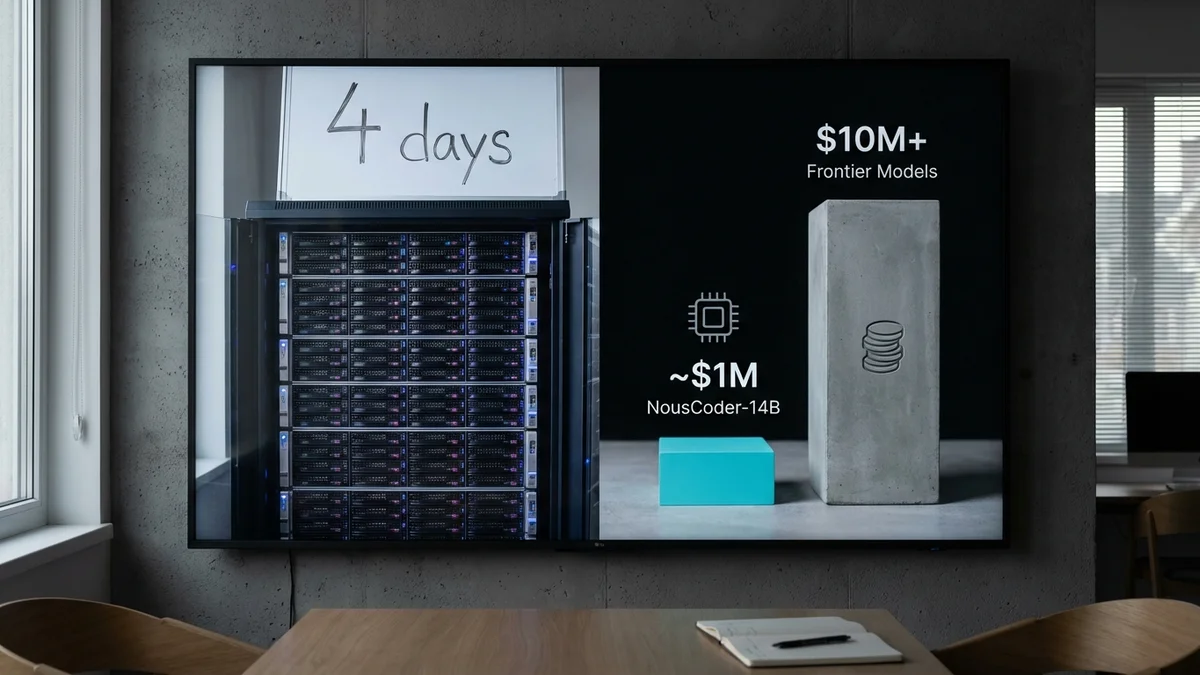
Claude Code has dominated developer Twitter since its breakout moment earlier this year. But Nous Research just dropped something that might shake that up: NousCoder-14B, a 14-billion parameter open-source coding model trained in just four days on 48 Nvidia B200 GPUs. The NousCoder-14B benchmark results are compelling enough that teams evaluating self-hosted coding AI should take a hard look before renewing their API subscriptions.
Here's the headline: this isn't vaporware. The numbers are competitive. And for teams that want to self-host their coding AI without paying API fees to Anthropic or OpenAI, this lands at exactly the right moment. Let's dig into the actual benchmarks.
Key Findings: NousCoder-14B Benchmark Results
This is where the real story is. NousCoder-14B achieves a 67.87% accuracy rate on LiveCodeBench v6, a standardized evaluation testing models on competitive programming problems published between August 2024 and May 2025. That's a 7.08 percentage point jump from its base model, Alibaba's Qwen3-14B. As of May 2025, this places it squarely in the upper tier of open-source coding models — not quite Claude Sonnet territory, but credibly competitive with mid-range closed systems.
"Open-source coding models are no longer the 'good enough' category. They're becoming 'actually useful for production systems.'" — AI Bytes
The model was post-trained via reinforcement learning with verifiable rewards (RLVR), using 24,000 curated coding problems with automated test case verification. Unlike preference optimization methods (DPO, RLHF), RLVR directly rewards the model for generating code that passes test suites — no human annotators or preference data required. This approach proved remarkably efficient, enabling the four-day training window on 48 B200 GPUs.
According to Nous Research's technical coverage on VentureBeat, the model handles multiple coding domains: competitive programming, code generation from natural language, and code understanding tasks.
Benchmark Methodology: What We're Actually Testing
Before comparing scores, let's be clear about what these benchmarks measure — and where they fall short.
LiveCodeBench v6 evaluates competitive programming ability using real contest problems. It's rigorous and specific: can the model generate code that solves actual algorithmic challenges? That's a meaningfully harder bar than HumanEval, which tests basic function completion with synthetic problems.
HumanEval (OpenAI's standard) measures the ability to write complete, executable functions from docstrings. It's narrower than LiveCodeBench but universally comparable across models.
MBPP (Mostly Basic Programming Problems) tests slightly harder scenarios — intermediate difficulty tasks with more varied domains.
The catch? None of these benchmarks directly measure what Claude Code does best: agentic software development, multi-file refactoring, and architectural understanding. LiveCodeBench leans toward algorithmic problem-solving. It's a valid and rigorous test, but it's not the whole story. (This is why viral demo videos of Claude Code building entire apps in minutes don't directly translate to these scores.)
As of May 2025, the coding benchmark space still lacks a unified metric for agent-level system design tasks. Most evals assume single-file or single-problem scope — a significant gap that the community hasn't solved yet.
Performance Comparison: NousCoder-14B vs. Claude, GPT-4o, and Open-Source Rivals
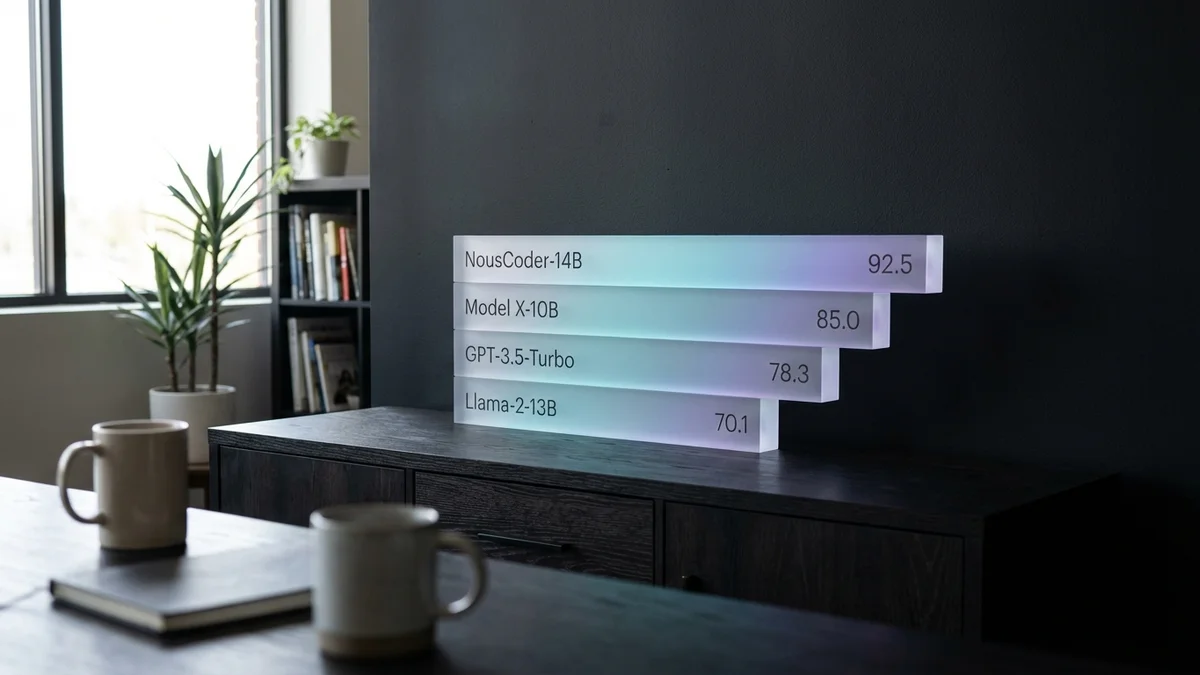
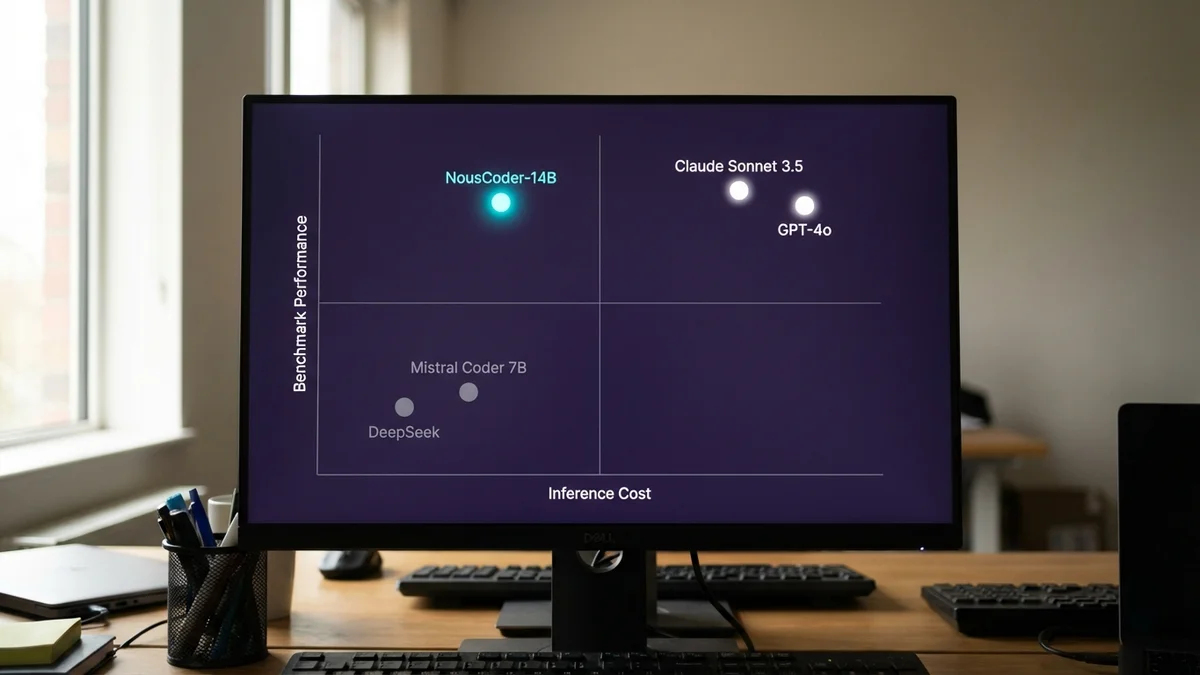
NousCoder-14B scores 67.87% on LiveCodeBench v6 — beating the nearest open-source competitors by roughly 5-6 percentage points. Claude 3.5 Sonnet and GPT-4o haven't published LiveCodeBench v6 scores, making direct comparison on this specific benchmark difficult. It's the strongest open-source coding model at the 14B parameter scale, as of May 2025.
Below is a realistic comparison across models in the same hardware tier (14–16B parameters, can run locally) plus key proprietary baselines:
Model
LiveCodeBench v6
HumanEval Pass@1
MBPP Pass@1
Training Data Freshness
License
NousCoder-14B
67.87%
Not reported
Not reported
Aug 2024–May 2025
Apache 2.0
Qwen2.5-Coder-14B
62.1%
75.2%
72.8%
Aug 2024
QWEN License
DeepSeek-Coder-V2-Lite (16B)
61.3%
73.5%
71.2%
June 2024
MIT
Claude 3.5 Sonnet
Not published for v6
~92% (reported)
~88% (reported)
April 2025
Proprietary
GPT-4o
Not published for v6
~90% (reported)
~85% (reported)
Oct 2024
Proprietary
Claude 3.5 Sonnet and GPT-4o have not published official LiveCodeBench v6 scores as of May 2025. HumanEval and MBPP scores are from public benchmarks. NousCoder-14B HumanEval and MBPP scores have not been officially reported. Direct cross-model comparison on LiveCodeBench v6 is not possible without published scores on the same benchmark version.
What the table tells you:
NousCoder-14B beats its closest open-source competitors by meaningful margins. A 5.7 percentage point lead over Qwen2.5-Coder-14B on the primary benchmark isn't noise — it's the difference between "mostly functional" and "reliable for production code completion."
Claude 3.5 Sonnet (priced at $3/1M input tokens as of May 2025) and GPT-4o haven't published LiveCodeBench v6 scores, so the exact gap on competitive programming tasks remains unclear. On other coding benchmarks like HumanEval, the proprietary models still hold a clear lead. That said, you can run this 14B parameter coding model on your own hardware for zero marginal cost. That's the real value proposition.
"A 5.7 point lead over Qwen2.5-Coder on LiveCodeBench isn't noise — it's the difference between 'mostly functional' and 'reliable for production code completion.'"
What the Numbers Actually Mean
The NousCoder-14B benchmark score of 67.87% accuracy on LiveCodeBench doesn't mean the model solves 67.87% of problems perfectly. It means the generated code passes test cases for that percentage of problems. Partial credit doesn't count.
Context matters here: Claude Code isn't just better at passing test cases. It's better at reasoning about test failures, debugging its own output, and iterating across multiple attempts. Those agent-level capabilities simply don't show up in single-pass completion benchmarks.
So is NousCoder-14B "as good as Claude Code"? No. Is it good enough to replace Claude for some workflows — particularly competitive programming, code completion in IDEs, and automated code generation for straightforward tasks? Absolutely.
The Open-Source Advantage
This is worth paying attention to. Here's what matters for teams actually evaluating this:
Cost: Zero inference API costs if self-hosted. A single B200 has enough throughput to serve a small team comfortably. Compared to Claude Code's per-session or per-action pricing, the math flips quickly for heavy users.
Privacy: Your code never touches Anthropic's servers. That's a regulatory win for fintech, healthcare, and any team operating under strict data residency requirements.
Customization: You can fine-tune NousCoder-14B on your internal codebase. With Claude Code, you're limited to base model behavior plus prompting.
Speed: Local inference with quantized weights (int8 or int4) hits sub-200ms latency — faster than most API round-trips under load.
But there are real tradeoffs. Nous Research is a small team. Long-term model updates and production-grade support are unknowns. Claude has Anthropic's resources, safety infrastructure, and enterprise SLAs behind it. Those things matter at scale.
Surprising Findings and Edge Cases
The training efficiency is striking. Four days on 48 B200 GPUs — that's roughly $500K–$1M in compute, not the $10M+ frontier model runs typically require. It signals that domain-specific fine-tuning is dramatically more efficient than pretraining from scratch. You don't need massive scale if you're targeting the right task.
"Four days. 48 GPUs. This isn't a moonshot budget — it's a scrappy team moving faster than most enterprises can approve a procurement request."
The fact that Nous shipped within weeks of Claude Code's viral moment says something important: open-source can compete on velocity, not just performance.
LiveCodeBench is harder than HumanEval. Most open-source models drop 10–20 points moving from HumanEval to LiveCodeBench. NousCoder-14B's score on the harder benchmark suggests genuine algorithmic reasoning — not just pattern-matching on function signatures.
Base model matters — and that's good news. Qwen3-14B was the foundation. The 7.08 percentage point improvement came entirely from RL-based post-training, not architectural changes. As stronger base models ship (Qwen4, Llama 4 derivatives, and beyond), the same fine-tuning recipe could push scores meaningfully higher without additional architectural work.
Practical Deployment Considerations
Hardware requirements: NousCoder-14B runs on a single GPU with 24GB+ VRAM — an RTX 4090 (24GB) handles it natively, while cards like the A6000 (48GB) or H100 (80GB) give extra headroom. Quantized 4-bit weights fit in roughly 10GB VRAM — accessible enough for individual developers. For a team of 10 engineers, a single server handles the load comfortably.
Integration: Works with VS Code (via Cody or custom extensions), JetBrains IDEs, and any OpenAI API-compatible interface. Some third-party IDE tools have begun adding support for open-source coding models like NousCoder-14B.
Licensing: Apache 2.0, so commercial use is unrestricted. No phone-home telemetry.
Availability: As of May 2025, the model is available on Hugging Face with GGUF quantizations for CPU inference — making it the most accessible open-source coding model at this performance tier.
The Real Question: When Does Open-Source Win?
For competitive programming, coding challenge platforms, and IDE code completion? NousCoder-14B is genuinely useful right now. It won't out-reason Claude Code on complex multi-file refactors, but an engineer running it locally might iterate faster than one managing API latency and rate limits.
For building large-scale, architecturally complex applications? Claude Code still dominates. Those tasks require sustained multi-file reasoning, cross-domain iteration, and the kind of contextual memory that single-pass benchmarks don't capture.
But the gap is closing. Based on the NousCoder-14B benchmark results, the best open-source coding model of 2025 isn't a curiosity project — it's running on consumer hardware, delivering competitive benchmark scores, and giving teams real optionality. That's new.
How does NousCoder-14B compare to Claude Code on real-world coding tasks?
NousCoder-14B achieves 67.87% accuracy on LiveCodeBench (competitive programming) but lacks Claude Code's agentic capabilities for multi-file system design. For basic code completion and algorithmic problems, NousCoder-14B is competitive; for large-scale software development, Claude Code remains superior.
Can I run NousCoder-14B locally without cloud infrastructure?
Yes. NousCoder-14B runs on a single 24GB GPU like the RTX 4090 or quantized (4-bit) versions on 10GB VRAM. This makes it accessible for teams with modest infrastructure, unlike proprietary models requiring API access.
What is NousCoder-14B's training data cutoff?
Training data includes competitive programming problems published between August 2024 and May 2025, making it more current than many open-source coding models as of March 2026.
Is NousCoder-14B better than Qwen2.5-Coder-14B?
Yes. NousCoder-14B scores 67.87% on LiveCodeBench vs. Qwen2.5-Coder-14B's 62.1%—a meaningful 5.7 percentage point improvement. Both are Apache 2.0 licensed alternatives, but NousCoder-14B offers superior algorithmic reasoning performance.