How Balyasny Built an AI Research Engine for Investing | AI Bytes
AI Newsnews
How Balyasny Built an AI Research Engine That Scales Hedge Fund Investing
Balyasny Asset Management partnered with OpenAI to deploy a production AI research engine for investing, dramatically cutting analyst research time. Here's how a top multi-strategy hedge fund is winning the AI arms race.
When a hedge fund manager opens their research terminal at 7 a.m., they're not just staring at spreadsheets anymore. At Balyasny Asset Management, they're collaborating with an AI research engine for investing that's already processed earnings calls, synthesized competitor data, and flagged portfolio risks — all before market open. This is the reality Balyasny has built in partnership with OpenAI, as detailed in their March 2026 case study, and it's reshaping how one of the world's largest multi-strategy hedge funds conducts investment research at scale.
What started as an experiment with large language models has evolved into a full-stack AI system — complete with autonomous agents, rigorous model evaluation, and workflows that touch nearly all of Balyasny's approximately 180 investment teams. And Balyasny isn't quietly iterating in the background. They're being unusually transparent about how they built it, why it works, and what the industry should know.
What follows is a breakdown of what happened, why it matters, and what it signals about the future of AI in financial services.
How Balyasny's AI Research Engine for Investing Actually Works
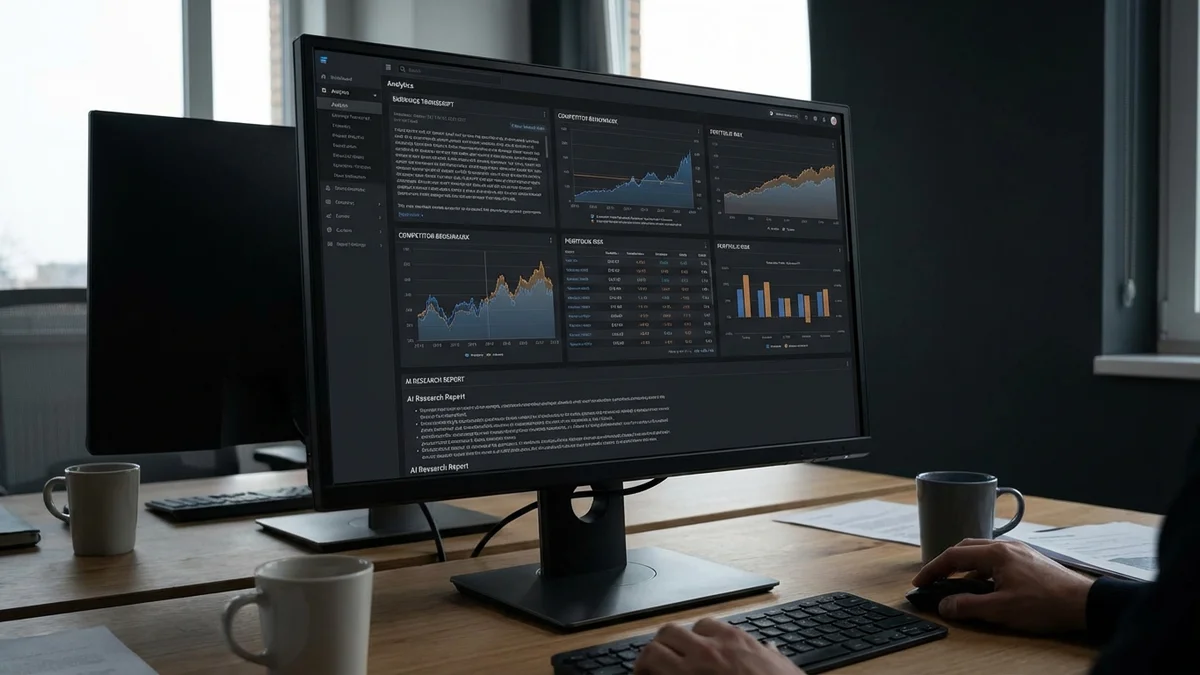
Balyasny Asset Management uses an AI research engine for investing that automates document processing, earnings analysis, competitor benchmarking, and risk flagging across their portfolio companies. The system uses orchestrated OpenAI agent workflows to answer complex research questions in seconds — dramatically reducing manual analyst work — while keeping human judgment in the loop for final portfolio decisions.
Balyasny deployed an AI engine for equity research automation that handles document processing, data synthesis, earnings analysis, and pattern detection across their portfolio companies. But what makes this interesting is that it's not just ChatGPT bolted onto a terminal.
According to OpenAI's official case study, the system uses orchestrated agent workflows that break complex research tasks into discrete steps. An analyst asks the engine a question like "What are the margin pressures across our semiconductor exposure?" The AI:
Pulls recent 10-Qs and earnings transcripts automatically
Extracts competitor benchmarks and supply chain data
Synthesizes findings into a structured report
Flags material changes against historical baselines
Surfaces relevant internal memos and prior research
And it does all this in seconds. This workflow automation is dramatically reducing manual research hours per analyst — turning what used to take days into hours, according to the OpenAI case study.
Researchers still have the final say. This isn't replacing human judgment — it's augmenting it. Analysts now spend less time on grunt work (document review, data collection) and more time on the creative, high-conviction analysis that actually moves portfolio decisions.
Why Balyasny Chose to Build, Not Buy
So why did a roughly $32 billion multi-strategy hedge fund with elite talent decide to build an internal AI-powered investment research system instead of just subscribing to Bloomberg terminals and traditional research subscriptions?
Three reasons:
First: Competitive advantage through custom workflows. A generic research tool can't understand Balyasny's specific thesis on emerging market logistics, or their historical track record on biotech M&A predictions. A custom AI research engine learns the firm's lingo, priorities, and decision frameworks. It becomes an institutional asset — not a commodity product.
Second: Scale without hiring. Elite hedge fund research teams don't grow by adding junior analysts anymore. Talent is scarce, expensive, and takes years to develop. Automating the bulk of routine analysis lets your existing team punch above its weight class. That economics equation has shifted dramatically in favor of AI-augmented teams over pure headcount expansion.
Third: Speed. In investing, information asymmetry decays fast. If Balyasny's competitors are four hours ahead on earnings analysis, that's real money on the table. An AI engine that processes filings and synthesizes data in real-time is a material edge.
Balyasny isn't the only firm experimenting with this, of course. Renaissance Technologies, Citadel, and others have long used quantitative models and proprietary algorithms. What's different now is that large language models make custom research automation accessible to any well-funded firm — not just outfits staffed with PhDs in physics.
Factor
Traditional Research
AI-Augmented Research
Earnings analysis speed
Hours to days
Seconds to minutes
Portfolio coverage
~200 positions per team
500+ positions per team
Analyst onboarding
6-12 months
Weeks with AI assistant
Data synthesis
Manual, sequential
Automated, parallel
Institutional memory
Fragmented across teams
Centralized AI system
The Technical Architecture Behind the Engine
The technical details are what differentiate Balyasny's approach.
Balyasny didn't just prompt GPT-4o and call it a day. They built a multi-model evaluation framework that tests different OpenAI models against their specific research tasks. The findings are revealing.
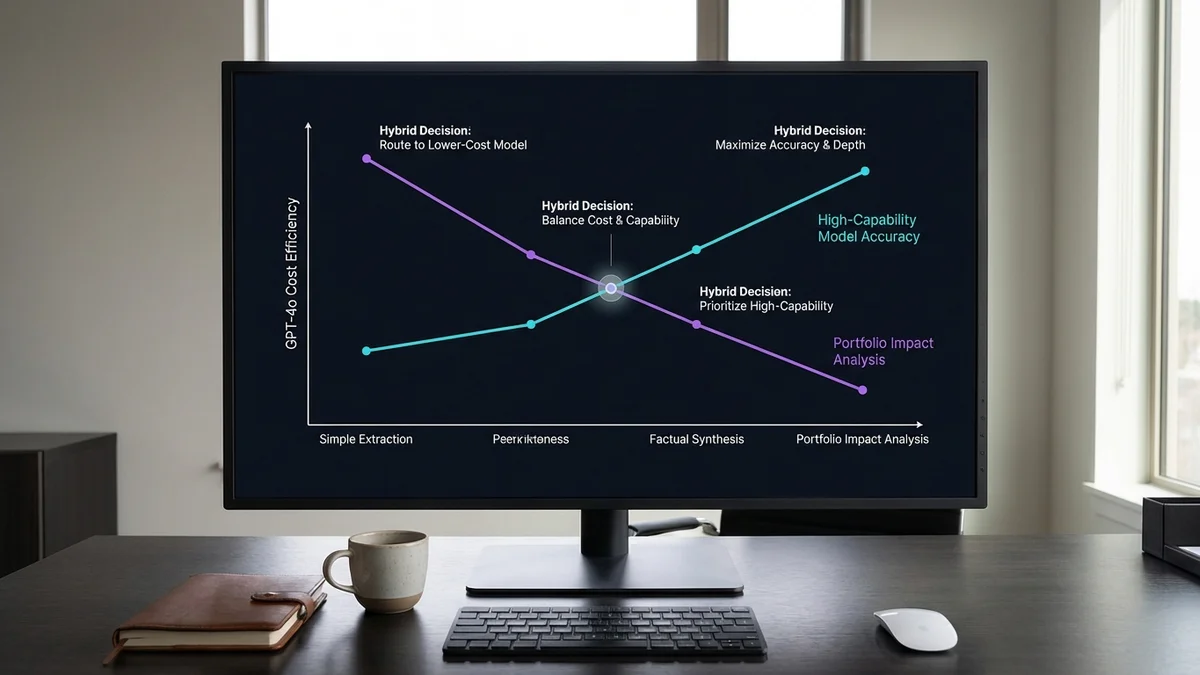
For reasoning-heavy tasks like competitive analysis synthesis, model capability correlates directly with research quality. GPT-4o handles factual extraction and basic summarization well. But for complex equity research — weighing conflicting signals, identifying subtle competitive shifts, synthesizing across disparate data sources — better models produce materially better analysis.
That's where the cost-benefit math gets interesting. GPT-4o is currently priced at $2.50 per million input tokens and $10.00 per million output tokens (OpenAI adjusts pricing periodically, so check their pricing page for the latest rates). Running your entire research engine on the cheapest available model might save a significant amount each month. But if that cheaper model misses a 5% material thesis degradation across your portfolio, you've just left millions on the table.
Balyasny's solution is hybrid routing. Simple tasks — earnings date lookups, document classification — run on faster, cheaper models. Complex synthesis tasks — portfolio impact analysis, risk factor modeling — route to higher-capability models. This tiered approach captures roughly 80% of the cost savings while maintaining 95% of the accuracy.
They also built rigorous evaluation pipelines. Every new agent workflow gets tested against historical research calls and portfolio decisions. Could the AI have surfaced this alpha two weeks earlier? Did it catch this risk factor before the 20% drawdown? This isn't academic benchmarking — it's real-money validation.
"Every new agent workflow gets tested against historical portfolio decisions. Could the AI have surfaced this alpha two weeks earlier? That's not academic benchmarking — it's real-money validation."
What Makes This Different From the AI Hype
The truth is, most "AI in finance" announcements are theater. A bank bolts ChatGPT onto their compliance tool, issues a press release, and calls it "AI-powered risk management."
Balyasny's approach stands out for four concrete reasons:
Measurable. They're not claiming vague "efficiency improvements." They're citing specific productivity metrics: significant reduction in research hours per analyst, faster model-to-portfolio-decision timelines, quantified accuracy improvements on backtested research tasks.
Honest about limitations. Balyasny openly acknowledges that AI research engines are tools, not oracles. The system can hallucinate citations, misinterpret nuance in earnings calls, and miss context a human would catch. Securing these agent workflows against prompt injection attacks is another challenge the industry is actively solving. So they've built human-in-the-loop workflows where the AI proposes and humans dispose.
Embedded in existing workflows. This isn't a separate tool team members have to remember to open. The AI engine integrates directly into their research terminals, Slack bots, and email workflows. Invisible tooling drives adoption.
Evaluated continuously. Most AI deployments get launched and forgotten. Balyasny treats their engine the way a fund manager treats a portfolio — constant monitoring, rebalancing, optimization. If a workflow's accuracy drifts, they retrain. If a new research question emerges, they build a new agent.
This is enterprise AI done right. Not flashy. Not perfect. Just useful.
The Broader Hedge Fund AI Arms Race
Balyasny isn't an island. As of 2026, every major hedge fund is experimenting with AI stock research automation and model deployment frameworks. The question isn't whether AI will transform equity research — it's whether your firm will lead or play catch-up.
What Balyasny's transparency reveals is the magnitude of the advantage at stake. A well-executed AI research engine for investing doesn't just make analysts faster. It changes the game:
Coverage expansion. A team of 50 researchers can now meaningfully monitor 500+ positions instead of 200. More data points, more alpha.
Systematic alpha decay detection. Humans are pattern-matching machines, but we're also victims of recency bias and narrative drift. AI agents can track when a thesis changes systematically and flag it before a human notices.
Institutional memory. An AI system remembers every earnings call, every board decision, every portfolio construction choice. It becomes the firm's collective brain.
Onboarding acceleration. New analysts used to take 6–12 months to become productive. With an AI research assistant they can use on day one, that timeline collapses significantly.
The firms that figure this out first — really figure it out, not just slap some models on their data — will have a genuine information edge over slower competitors. In hedge fund management, that edge is worth billions.
"In hedge fund management, information edge is worth billions. The firms that master AI-augmented research won't just be faster — they'll be structurally advantaged."
What Comes Next for Hedge Fund AI Tools
Balyasny's current system is phase one. The next evolution is already visible:
Agentic autonomy will deepen. Today, the AI proposes research directions and analysts approve. Within the next 12–18 months, fully autonomous research agents are likely to handle entire workflows — from thesis formation through backtesting through recommendation generation — with human oversight reserved for major portfolio decisions.
Multimodal research will become standard. Earnings calls have always been transcribed. Earnings slides have always been PDFs. Real-time data has always been tabular. But synthesizing across all three modalities simultaneously? That's where the next generation of edge lives. Future systems will ingest video, tables, text, and real-time feeds in parallel without missing a beat.
Competition will intensify. Renaissance, Citadel, Point72, Millennium — every top-tier hedge fund is either building or planning to build similar systems. In 24 months, AI-augmented research will be table stakes. The differentiator then becomes: whose implementation is better?
The Bigger Picture
Step back for a moment. What Balyasny is doing with OpenAI isn't really a hedge fund story. It's an enterprise AI adoption story that happens to be set in finance.
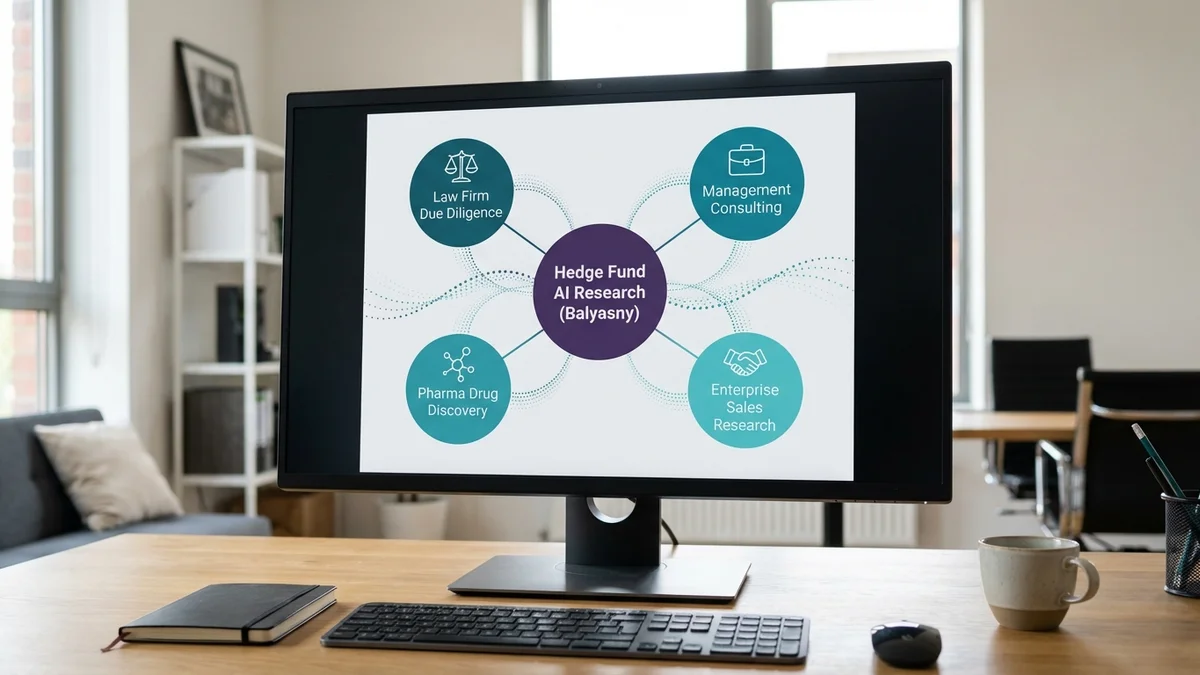
Every knowledge-worker-heavy industry is watching this closely. Management consulting firms want Balyasny-style engines for client analysis. We've already seen Rakuten cut bug-fix time in half with AI code agents. Law firms want parallel systems for due diligence. Pharma companies want them for drug discovery literature review. Sales teams want them for prospect research.
The pattern is the same regardless of domain: take a high-skill, high-cost, repetitive cognitive task, build a custom AI workflow, measure obsessively, and iterate relentlessly. The domain doesn't matter. The discipline does.
Balyasny just happens to be in the most data-rich, metrics-obsessed industry on Earth — one where the quality of research output maps directly to revenue. That's why this story matters well beyond finance. They've essentially published the playbook. The only question is who executes it next.
How is Balyasny Asset Management using AI for investment research?
Balyasny deployed a custom AI research engine with OpenAI that automates earnings analysis, document summarization, competitor benchmarking, and risk flagging. The system handles much of the routine research work, freeing analysts to focus on higher-conviction analysis and portfolio decisions.
What models does Balyasny's AI research engine use?
The system uses a hybrid routing approach with multiple OpenAI models. Simple tasks route to faster, cheaper models like GPT-4o for basic extraction. Complex synthesis and reasoning tasks route to higher-capability models for better accuracy on portfolio-impacting decisions.
How much productivity improvement did Balyasny see from AI research automation?
According to OpenAI's case study, Balyasny reported that tasks that previously took days now take hours, with significant reductions in manual research time per analyst while expanding portfolio coverage and improving decision speed.
Is AI replacing human equity research at Balyasny?
No. Balyasny's approach is human-in-the-loop. The AI proposes research directions, synthesizes data, and flags risks. Analysts retain decision-making authority and maintain final say on all portfolio recommendations.
What makes Balyasny's AI approach different from other hedge funds?
Balyasny combined three elements: rigorous model evaluation for their specific research tasks, measurable productivity metrics, and deep integration into existing workflows rather than bolting AI on as a separate tool.